



Choosing a project management platform in 2026 remains unexpectedly difficult. Dozens of tools handle tasks, timelines, and Gantt charts, yet convergence has blurred distinctions: Monday expanded into CRM and development modules, ClickUp absorbed documents and chat, Notion layered project views onto databases, and Jira rebuilt its entire interface. The race toward “everything apps” has paradoxically made genuine differences harder to identify.
After analyzing 2025–2026 updates across the market, a clear pattern emerges: tools that commit to a specific workflow philosophy outperform those attempting universal appeal. Height, the AI-native challenger, shut down in September 2025 when incumbents matched its core differentiator. Meanwhile, Linear reached $100 million ARR at a $1.25 billion valuation by remaining relentlessly opinionated.
This guide examines ten platforms through verified use cases, pricing structures, and architectural trade-offs. The tools covered are:
- ONES
- Monday.com
- Asana
- ClickUp
- Jira
- Notion
- Linear
- Wrike
- Smartsheet
- Basecamp
Quick Comparison
| Platform | Best For | Free Plan | Starting Price |
|---|---|---|---|
| ONES | Enterprise R&D organizations | Limited trial | Custom enterprise pricing |
| Monday.com | Visual teams and leadership | 2 users | $9/seat/month |
| Asana | Cross-functional coordination | 10 users | $10.99/user/month |
| ClickUp | Feature-dense all-in-one teams | Unlimited members | $7/member/month |
| Jira | Software engineering teams | 10 users | $7.75/user/month |
| Notion | Knowledge-centric workflows | Personal use | $12/seat/month |
| Linear | Fast-moving product teams | 250 issues | $8/member/month |
| Wrike | Marketing operations | 5 users | $10/user/month |
| Smartsheet | Data-driven project management | None | $9/member/month |
| Basecamp | Simplicity-focused small teams | None | $15/user/month |
1. ONES
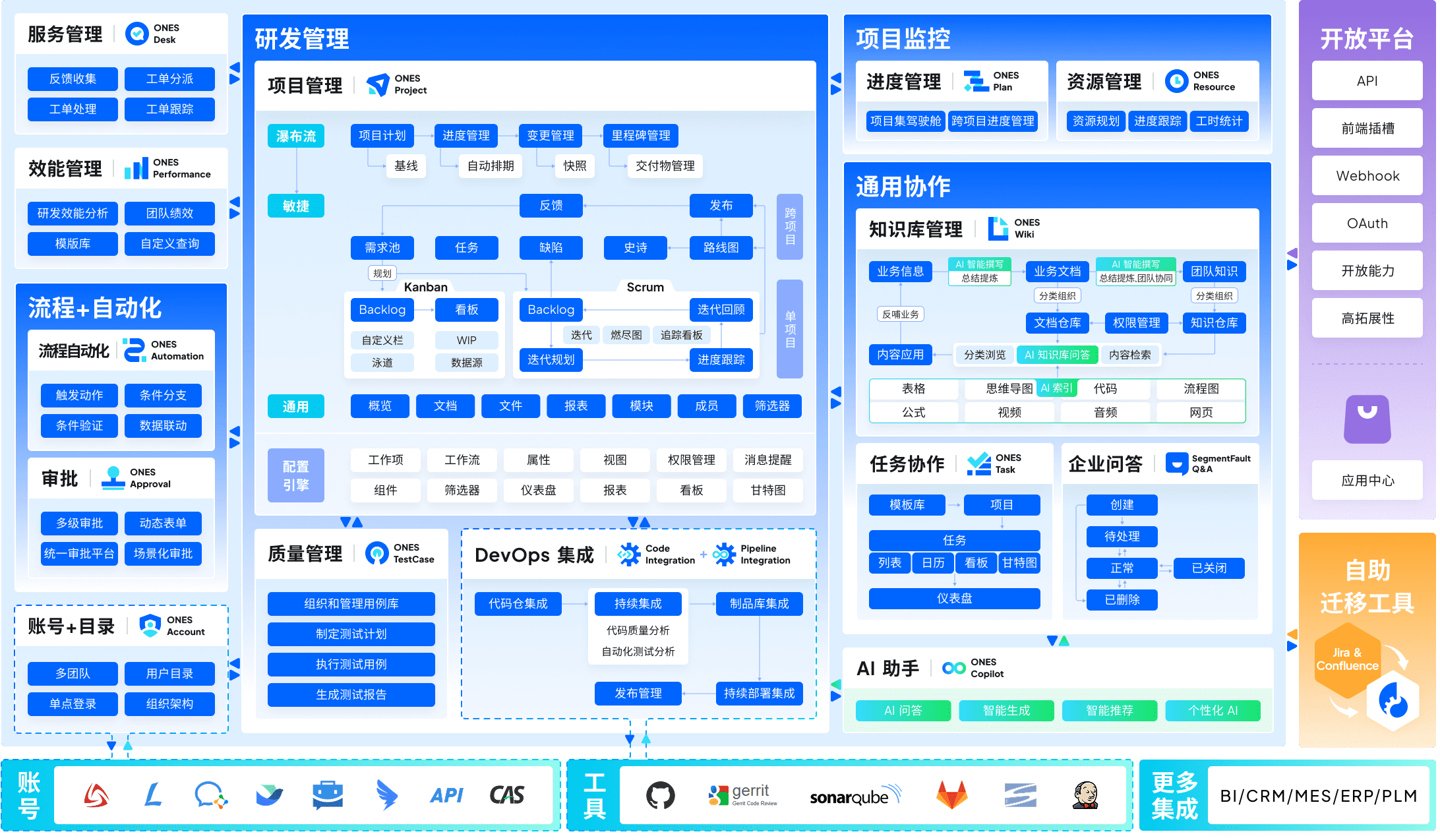
ONES occupies a distinct position as an enterprise-grade research and development management platform designed for organizations where software delivery is core to business operations. Unlike generalist tools that accommodate multiple departments through configurable templates, ONES constructs its architecture around the complete lifecycle of engineered products.
The platform integrates project management, requirements traceability, knowledge repositories, test management, CI/CD pipeline orchestration, and source code governance within a unified environment. This consolidation addresses a specific enterprise pathology: the fragmentation that occurs when engineering organizations stitch together six to twelve specialized tools, each with separate authentication, data models, and integration maintenance overhead.
Where ONES diverges most significantly from alternatives is in its governance capabilities. The platform supports multi-layered permission models, complex workflow configurations with conditional branching, and cross-functional team coordination at organizational scale. These capabilities target scenarios where a 500-person engineering division must maintain consistent process standards across thirty autonomous squads while preserving visibility for portfolio management.
The measurement infrastructure represents another architectural commitment. ONES embeds engineering effectiveness metrics directly into operational workflows rather than treating analytics as a separate reporting layer. Teams can correlate process changes with delivery outcomes, identify bottleneck patterns across value streams, and construct data-informed improvement cycles without extracting data into external business intelligence tools.
Implementation characteristics warrant consideration. ONES requires substantial configuration investment during deployment and presumes organizational maturity in process definition. Teams seeking immediate task-board functionality with minimal setup will find the onboarding trajectory longer than consumer-oriented alternatives. The return on this investment manifests in environments where compliance requirements, audit trails, and standardization across business units are non-negotiable constraints.
2. Monday.com
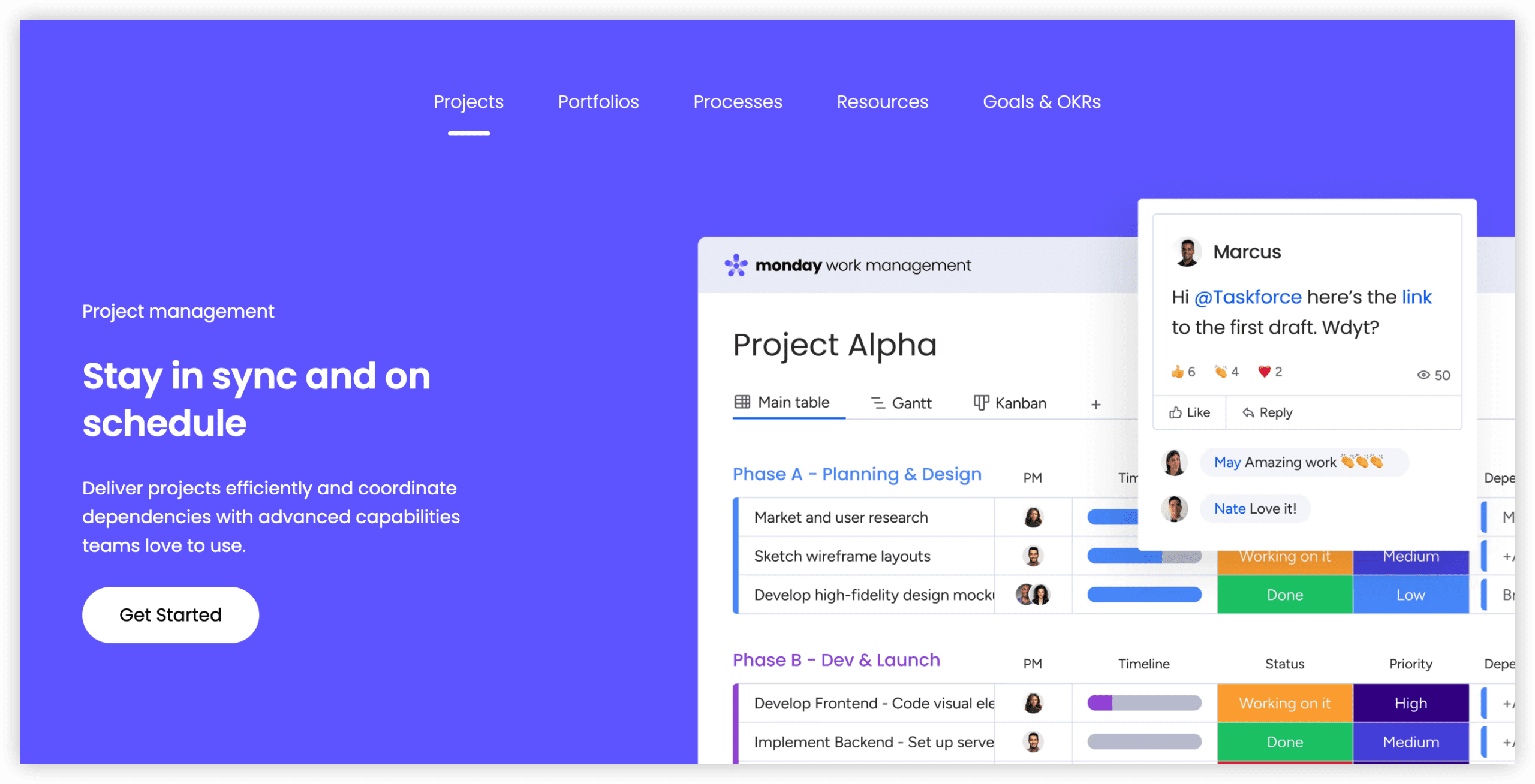
Monday.com has transcended its origins as a visually distinctive kanban application to become a comprehensive work operating system. The current architecture comprises four specialized modules—Work Management, CRM, Dev, and Service—unified by a consistent board-based data model but differentiated through domain-specific configurations.
Pricing structures at $9, $12, and $19 per seat monthly, with a three-seat minimum on paid tiers and a restricted free tier for two users. The executive dashboard capabilities constitute the platform’s most defensible advantage: multi-board data aggregation, health indicators, resource utilization visualizations, and timeline overlays that translate operational data into presentation-ready formats without manual compilation.
The 2025 AI feature expansion introduced automated project construction, intelligent item clustering, and formula generation through natural language. The low-code application builder, branded as a coding-adjacent tool, achieved notable commercial traction with $1 million ARR within ten weeks of launch. These extensions suggest Monday.com is positioning itself as a platform for operational application development rather than pure project coordination.
Structural limitations persist for sophisticated users. The board hierarchy lacks depth for nested work decomposition beyond single-level subtasks. The automation engine, while functional, imposes constraints that ClickUp’s equivalent does not. Cost escalation becomes material for organizations exceeding twenty seats, particularly when multiple modules activate simultaneously.
3. Asana
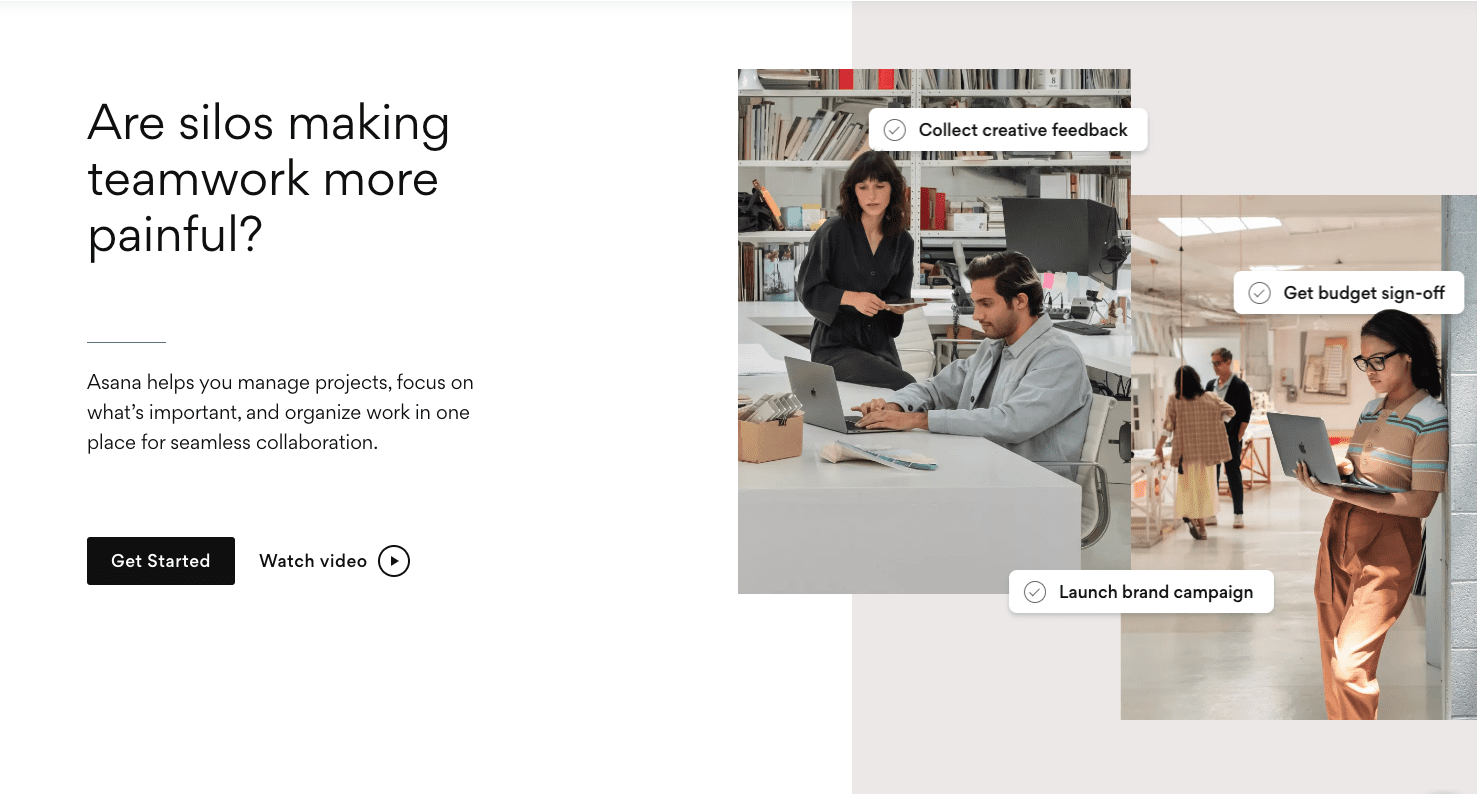
Asana occupies an intermediate position between visual accessibility and functional comprehensiveness. Its organizational hierarchy—portfolios containing projects containing tasks containing subtasks—establishes explicit linkages between daily execution and strategic objectives without requiring manual mapping maintenance.
The free tier accommodates ten users. Paid entry at $10.99 per user monthly escalates to $24.99 for advanced capabilities, with enterprise arrangements negotiated individually.
The workflow construction interface merits particular attention for operational repeatability. Users define stage sequences, conditional triggers, and automated actions: a task entering “Client Review” might simultaneously notify assigned account managers, establish three-day deadlines, and generate dependent approval subtasks. Crucially, these workflows operate across project boundaries, enabling a single task to exist within both a “Website Redesign” initiative and a “Creative Team” capacity view without data duplication.
Asana Intelligence, the 2025 AI augmentation, delivers project status synthesis, conversational task extraction, and risk flagging. These capabilities reduce update preparation time marginally—approximately ten to fifteen minutes per status cycle—rather than restructuring work methods fundamentally.
The platform’s architectural boundary is deliberate specialization. Asana does not attempt document editing, synchronous messaging, or customer relationship management natively. Organizations seeking consolidated tool stacks will find Monday.com or ClickUp more comprehensive. Teams content with Slack for communication and dedicated document platforms for knowledge work will find Asana’s project coordination capabilities sufficiently refined.
4. ClickUp
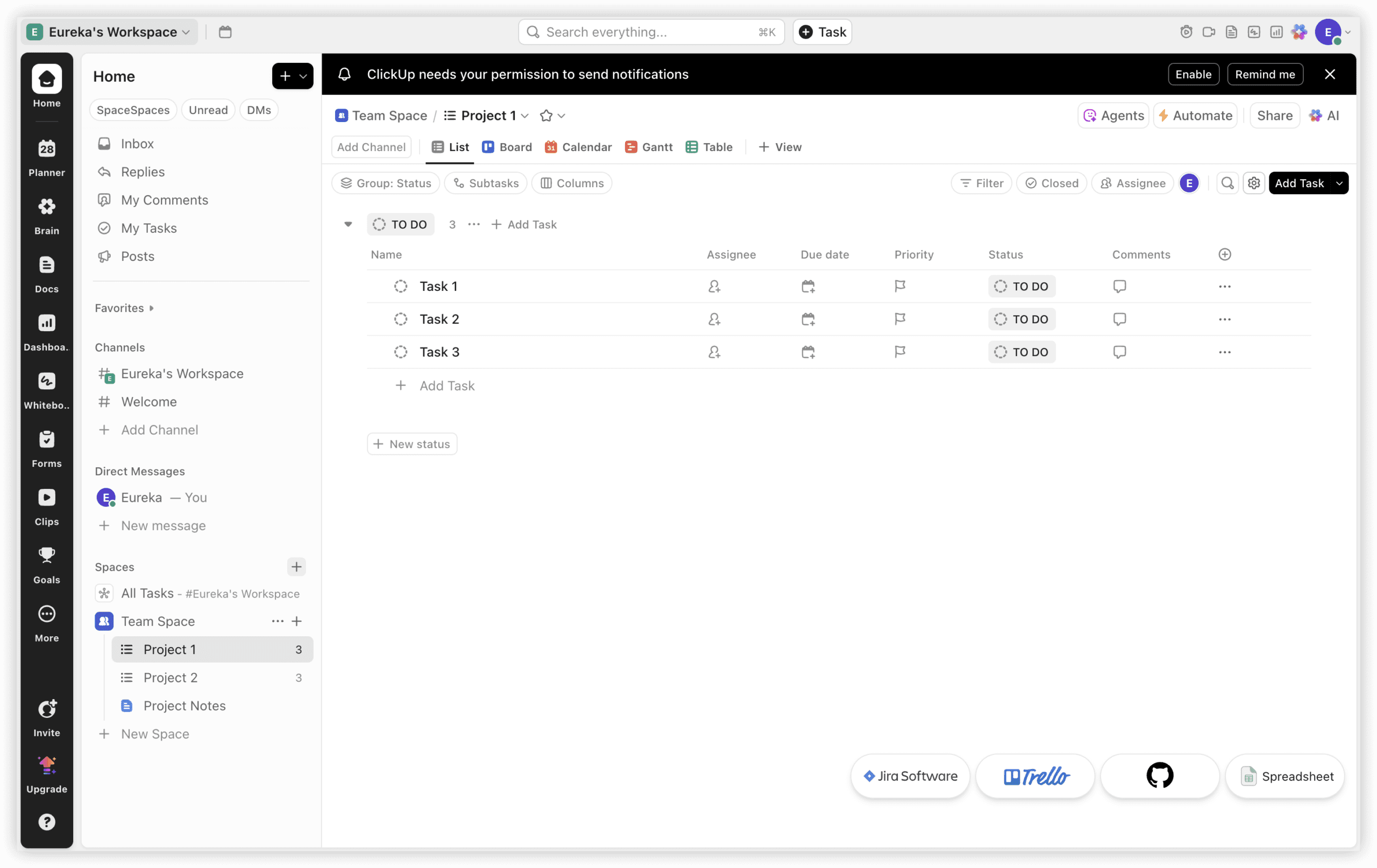
ClickUp represents the maximalist approach to work platform design. The feature inventory encompasses task management, document editing, collaborative whiteboarding, team chat, objective tracking, time logging, form collection, dashboard construction, and asynchronous video communication. At $7 per member monthly, the value density is unmatched in the category.
The 2025 strategic acquisitions of Qatalog and Codegen reinforced the “tool consolidation” thesis. ClickUp Brain, the integrated AI layer, now generates project structures from natural language prompts, composes task updates, and constructs automation rules from conversational descriptions.
The unrestricted free tier—supporting unlimited tasks and unlimited members with functional limitations on storage and premium capabilities—remains among the most permissive offerings available.
Performance characteristics present the primary caveat. Workspaces exceeding fifty members and thousands of active tasks experience intermittent latency. The interface density, consequence of feature breadth, imposes cognitive load. New team members typically require two to four weeks to achieve operational proficiency.
The assessment distinction between value and experience is essential. ClickUp delivers superior capability per expenditure unit. However, teams prioritizing velocity and interface clarity may prefer more focused alternatives—Linear, Basecamp, or Todoist—despite their narrower scope.
5. Jira
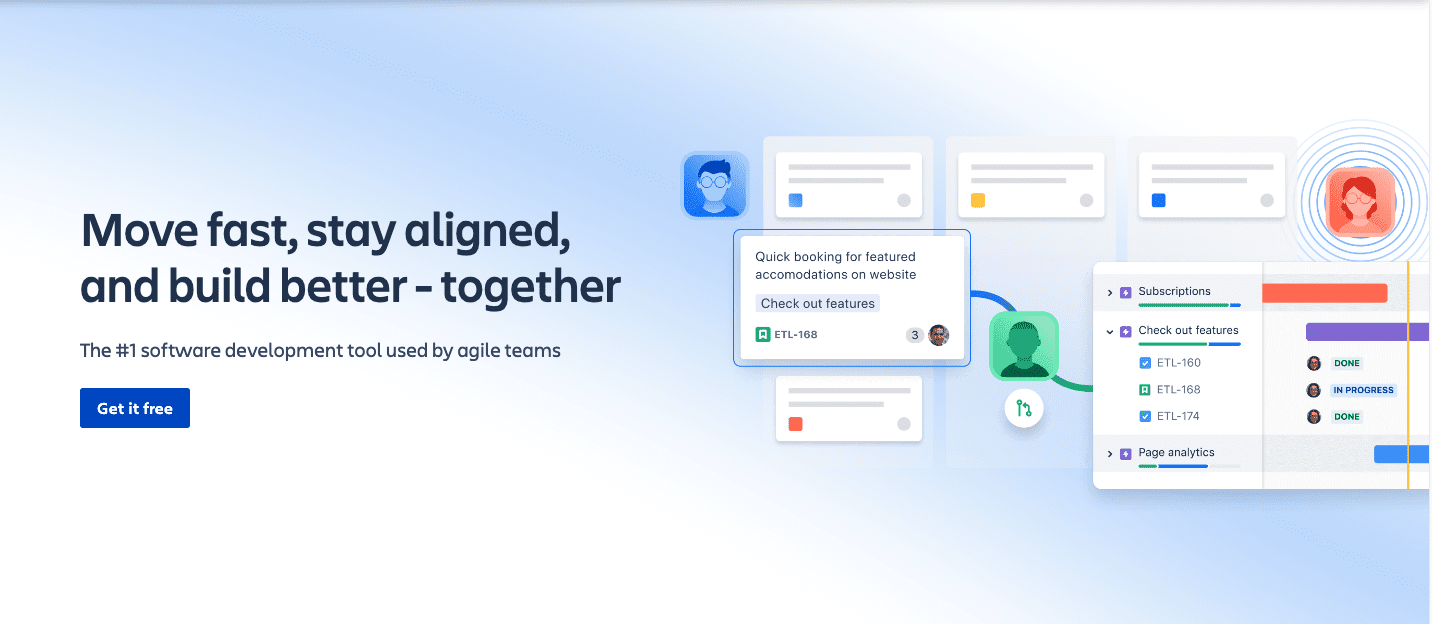
Jira maintains market dominance for software development coordination, serving over 65,000 organizations. Atlassian’s 2025 interface reconstruction addressed longstanding usability criticisms through unified navigation, visual simplification, and pervasive AI integration.
The pricing structure offers free access for ten users, with Standard at $7.75 and Premium at $15.25 per user monthly, plus enterprise arrangements.
Workflow depth for engineering processes constitutes the core differentiation. Sprint planning, backlog maintenance, board visualization, roadmap construction, release management, defect tracking, and source control integration (Bitbucket, GitHub, GitLab) operate as native capabilities rather than third-party extensions. JQL provides expressive filtering and reporting, though mastery requires dedicated investment.
Atlassian Intelligence powers AI augmentations including story point estimation suggestions, epic summarization, and foundational issue description generation. The Confluence integration establishes a natural documentation and project management pairing.
The established criticism retains validity. Project initialization demands template selection, workflow configuration, issue type definition, and permission architecture decisions. Non-engineering teams encounter unfamiliar terminology—sprints, epics, stories, velocity—that creates adoption friction. Jira excels for software organizations and functions poorly for most other contexts.
6. Notion
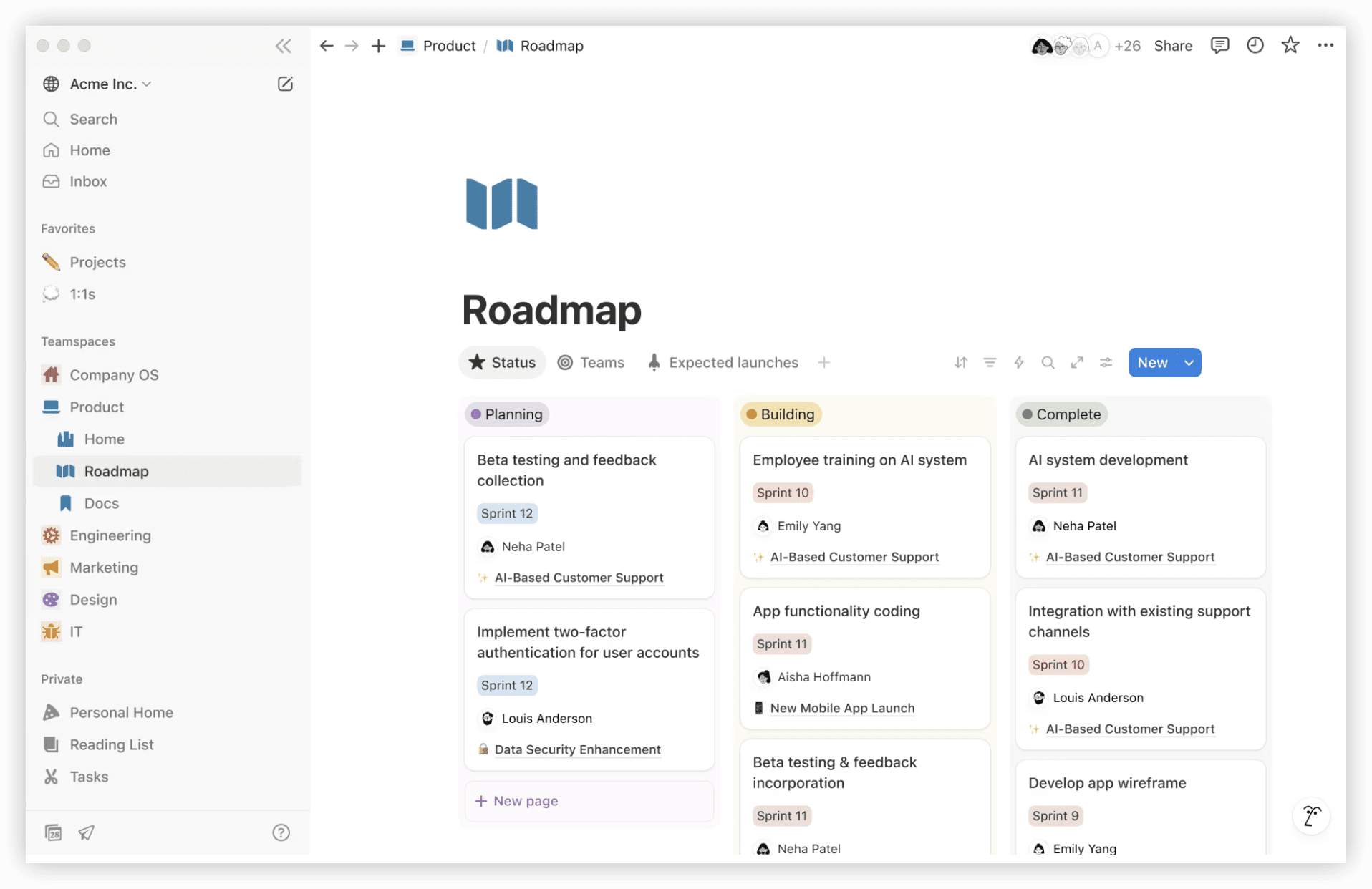
Notion continues dissolving boundaries between knowledge repositories and project coordination. Its database engine enables custom project views—kanban boards, tabular displays, timeline visualizations, calendar presentations—coexisting with wikis, meeting records, and specification documents.
Personal use remains free. Team access begins at $12 per seat monthly, with Business tier at $18.
The distinctive strength is contextual project execution. Project databases link directly to specification documents, meeting notes, and research compilations. Selecting a task reveals not merely assignment and deadline, but the complete informational context surrounding that work unit. For knowledge-intensive domains—consulting, research operations, content production—this integration eliminates the friction of switching between information storage and task tracking systems.
Notion AI, available as a $10 per member monthly supplement, synthesizes database contents, responds to workspace content queries, and auto-populates properties. The assistant capabilities for information navigation and synthesis have matured substantially.
Performance constraints are material. Rendering speed lags behind Linear or Asana, particularly on large databases. Native time tracking and built-in automation are absent (though API integrations and button-based workflows provide partial alternatives). Permission granularity falls below dedicated project management platforms. Notion optimizes for teams that conceptualize work through documents, with task management as secondary structure.
7. Linear
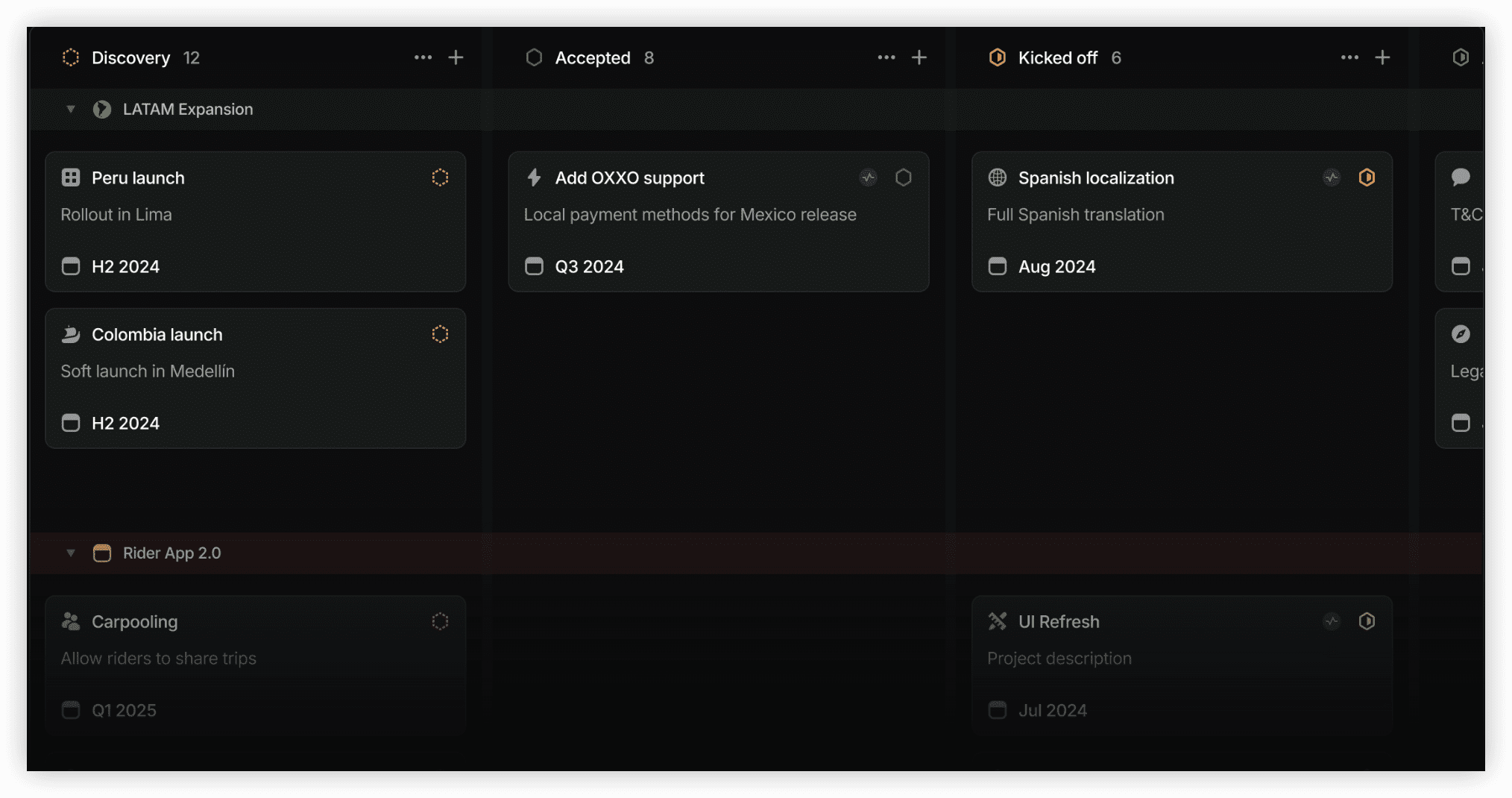
Linear has emerged as the fastest-expanding developer-focused coordination tool, validated by $100 million ARR achievement at $1.25 billion valuation. Its design philosophy centers on velocity and prescriptive interaction patterns: keyboard-prioritized navigation, instantaneous search, and workflows that mirror actual software construction practices.
The free tier supports 250 active issues. Standard access at $8 per member monthly advances to $14 for Plus capabilities.
The product ethos of “reduced scope, elevated execution” manifests in polished, performant features. Cycle planning (Linear’s sprint equivalent), triage workflows, and project visualizations serve teams operating on consistent shipping cadences. GitHub and GitLab integrations maintain tight coupling—pull requests automatically propagate issue status changes.
2025 AI additions include automatic bug categorization, velocity-based sprint recommendations, and release note generation from completed work. These capabilities feel architecturally integrated rather than superficially appended.
The scope boundary is explicit and restrictive. Linear serves software product teams exclusively. Client portals, time tracking, invoicing, and marketing workflows are absent. Agency operations, general business functions, and non-engineering departments find no accommodation. For development teams of five to one hundred members constructing software products, Linear’s speed and focus remain unmatched.
8. Wrike
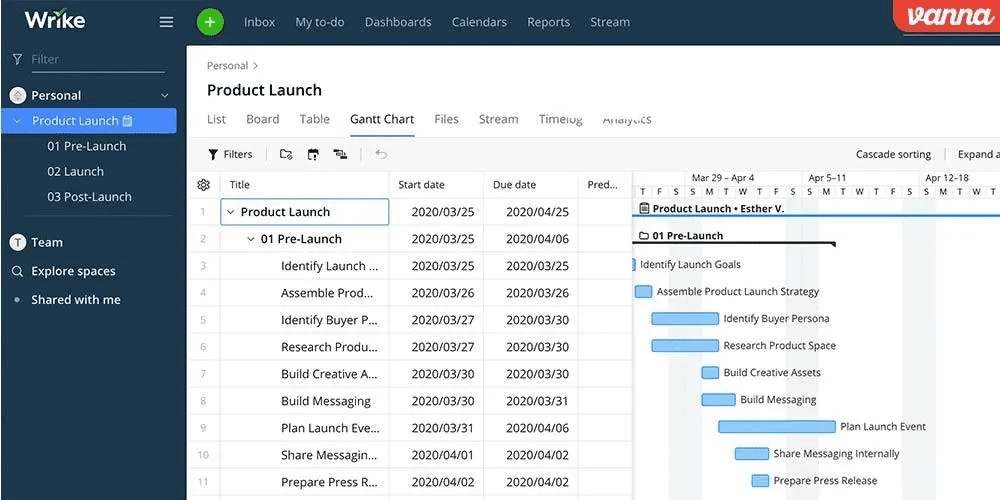
Wrike sustains its position as the most capable platform for marketing operations and creative production. Native proofing workflows, approval routing, and brand asset management address requirements that generalist tools systematically neglect.
Free access for five users precedes Team tier at $10 per user monthly and Business tier at $24.80.
The 2025 “Work Intelligence” rollout introduced AI capabilities across all tiers: project risk scoring, effort estimation, and skill-based automated task assignment. Wrike Integrate provides connectivity to 400+ applications through native connectors and a Workato-powered automation engine.
Request form infrastructure represents an underappreciated strength. Distinct forms for distinct work categories, each with customized routing, assignment, and automation rules, prevent request overflow for teams processing fifty or more weekly submissions.
The pricing structure presents a steep discontinuity. Team tier includes foundational capabilities, but most organizations require Business tier for resource management, time tracking, and request forms. The 2.5x escalation between tiers exceeds any comparable platform in this evaluation.
9. Smartsheet
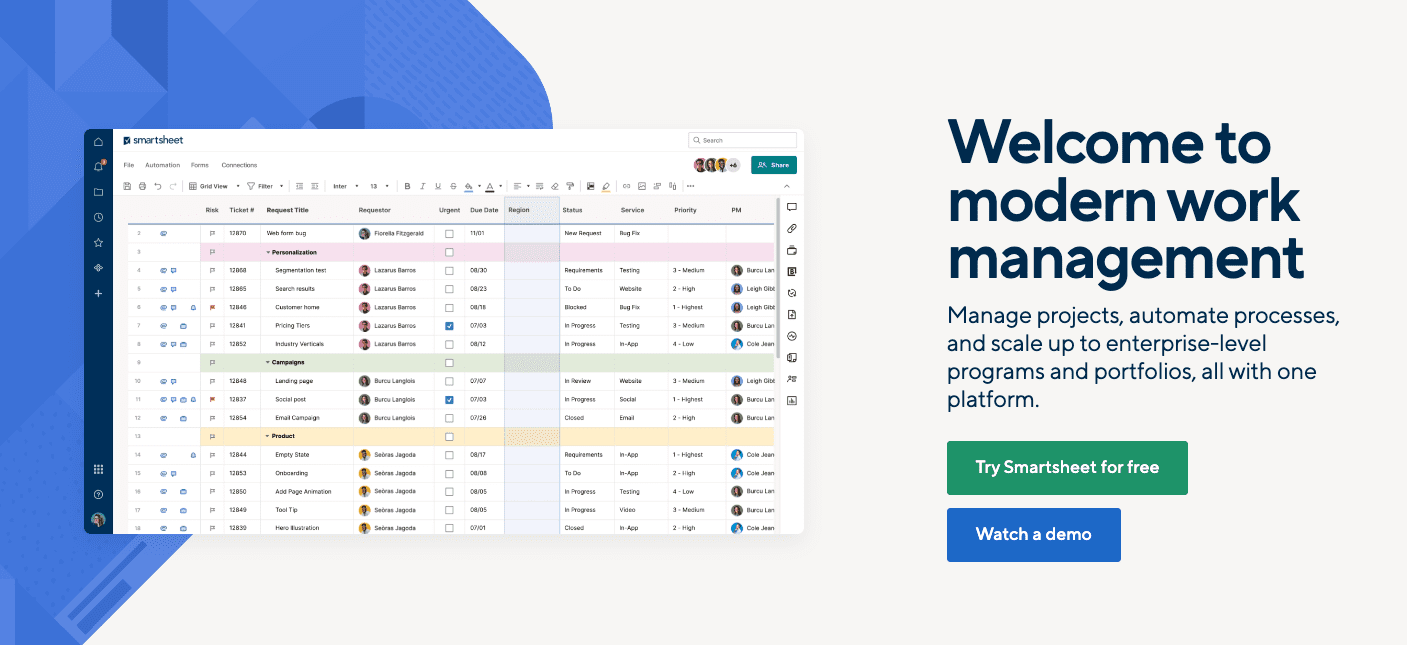
Smartsheet targets teams with spreadsheet-centric cognitive models. The fundamental interface preserves grid structures—rows, columns, cells—with Gantt charts, card views, automation engines, and dashboard layers superimposed.
Pro tier at $9 per member monthly, Business at $19, with enterprise pricing negotiated.
The spreadsheet metaphor carries genuine power for data-intensive project domains. Construction, manufacturing, event logistics, and operations teams frequently manage work in Excel already. Smartsheet preserves established interaction patterns while adding project management capabilities that spreadsheet software cannot provide natively.
Cross-sheet formulas and DataMesh (inter-sheet data linking) enable connected dashboard construction aggregating information from multiple initiatives. The reporting engine benefits from spreadsheet-inherited filtering and grouping flexibility that exceeds most dedicated alternatives.
Collaborative capabilities trail competitive standards. Real-time co-editing exists but exhibits latency. Discussion functionality is rudimentary. Teams requiring intensive daily collaboration find Asana or Monday.com more natural. Smartsheet optimizes as structured data management with project coordination features, rather than as collaboration-first platform.
10. Basecamp
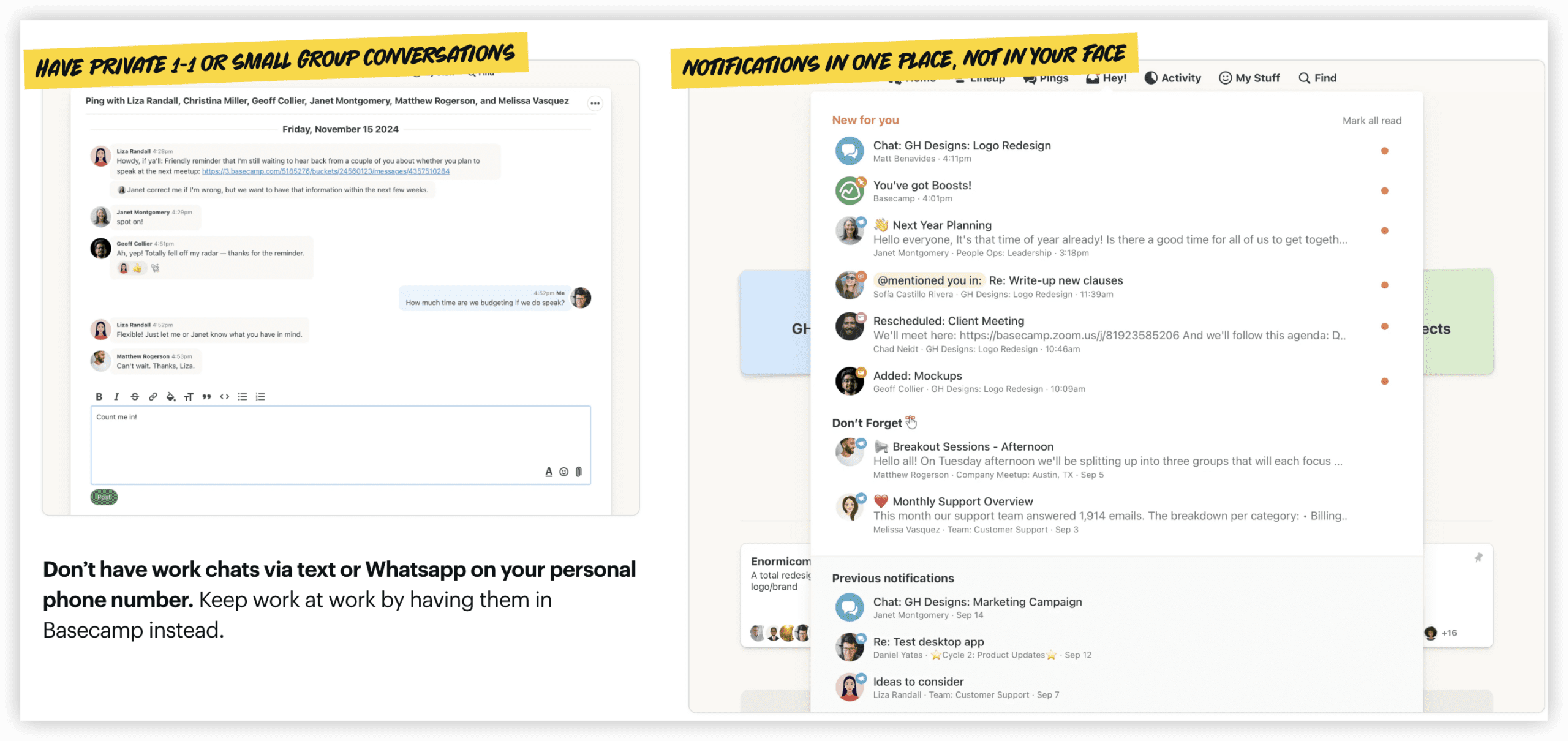
Basecamp inverts the industry trajectory of feature accumulation. While competitors expand, Basecamp deliberately constrains capability scope. Each project receives exactly six tools: message board, task lists, schedule, document storage, synchronous chat, and periodic check-ins.
Pricing shifted from historical flat-rate model to $15 per user monthly, with Pro Business flat rate at $299 monthly for unlimited users. The flat option achieves economic viability only above approximately twenty team members.
The philosophical alignment with “Shape Up” methodology—six-week scoped bets with defined shipping boundaries—creates natural workflow support for cycle-based teams. The deliberate absence of Gantt charts reflects founder conviction that such visualizations generate false precision.
The served constituency is narrow: small teams prioritizing work clarity over capability breadth. The frustrated constituency is broader: anyone requiring task dependencies, resource allocation, custom field taxonomy, or detailed operational reporting encounters fundamental architectural boundaries.
Selection Framework
Matching organizational characteristics to platform architecture:
- Enterprise R&D organizations with compliance and scale requirements: ONES for integrated lifecycle governance and cross-team standardization
- Software engineering, established enterprise: Jira for workflow depth and ecosystem maturity
- Software engineering, startup or scale-up: Linear for velocity and focused execution
- Marketing and creative operations: Wrike for proofing and approval infrastructure
- Cross-functional coordination: Asana for balanced structure and flexibility
- Client service or agency operations: Teamwork for native billing and external stakeholder access
- Knowledge-intensive, document-primary workflows: Notion for contextual task-information integration
- Maximum capability density, minimum expenditure: ClickUp at $7 per member monthly
- Simplicity preference, small team: Basecamp for constrained, calm operation
- Data-heavy, spreadsheet-native teams: Smartsheet for familiar interaction patterns with project management augmentation
Frequently Asked Questions
Are project management platforms becoming indistinguishable?
Feature catalogs increasingly overlap. Monday.com, ClickUp, and Notion all incorporate documents, messaging, and AI assistance. However, underlying design philosophies remain distinct: Monday.com optimizes for visual accessibility, ClickUp for capability comprehensiveness, Notion for knowledge integration. Platform selection should prioritize philosophical alignment with team workflow patterns over feature checklist comparison.
What caused Height’s closure?
The AI-native platform ceased operations in September 2025. The founding team identified competitive pressure when established vendors rapidly implemented comparable AI functionality. The episode illustrates that AI capabilities alone constitute insufficient differentiation when market leaders can replicate features within development cycles.
Does Linear justify its market attention?
For software product teams, the performance characteristics—navigation speed, keyboard efficiency, prescriptive workflow design—translate to measurable daily productivity improvements. The “fast” attribute is architecturally embedded rather than promotional positioning. For non-technical teams, the narrow scope creates inappropriate constraints.
Should AI capabilities drive platform selection?
Current market state indicates convergence: task generation, status synthesis, and intelligent scheduling are becoming table stakes. Selection criteria should prioritize workflow fit, with AI features as secondary benefit rather than primary determinant. Analogously, automobile purchase decisions rarely center on audio system specifications.
What does platform migration involve?
Technical data transfer is solvable through CSV exchange or specialized migration services (Artifact, Import2). The substantive cost is workflow reconstruction, automation recreation, and behavioral adaptation. Organizations should allocate four to eight weeks for complete operational transition.
Conclusion
Effective project management platform selection requires matching structural intensity to organizational maturity and workflow characteristics. Insufficient structure permits work omission; excessive structure diverts effort toward tool maintenance rather than value creation. The optimal platform enforces the minimum viable coordination necessary for reliable execution without imposing bureaucratic overhead disproportionate to team scale and complexity.