



What project management software should IT and engineering teams adopt in 2026? After evaluating dozens of platforms across integration depth, enterprise governance, and delivery lifecycle support, we identified 10 tools that address distinct organizational needs. This guide lists each offering in order of suitability for complex technical environments.
- ONES — Best for integrated R&D lifecycle management
- Atlassian Jira — Best for agile software teams
- Monday.com — Best for visual workflow customization
- Asana — Best for cross-functional project coordination
- Microsoft Project — Best for traditional portfolio management
- Notion — Best for flexible knowledge-work fusion
- ClickUp — Best for all-in-one feature density
- Smartsheet — Best for spreadsheet-based execution
- Wrike — Best for marketing and creative operations
- Aha! — Best for product strategy-to-roadmap alignment
What Defines Effective Project Management Software in 2026
Technical teams face persistent fragmentation: requirements live in one system, tasks in another, and documentation scatters across unconnected repositories. Effective platforms now consolidate these layers or provide native bridges between them. For organizations beyond early-stage scale, governance capabilities— configurable workflows, granular permissions, and cross-project visibility — have become as critical as task tracking itself.
Research indicates that tool proliferation directly correlates with delivery delays. A 2025 industry analysis found that teams juggling four or more discrete applications experienced 34% longer cycle times than those operating within unified environments. This reality elevates integration architecture from convenience to strategic necessity.
How These Tools Were Evaluated
Each platform underwent assessment across six dimensions relevant to technology-driven organizations:
- Lifecycle coverage: Extent of support from ideation through delivery and retrospection
- Enterprise governance: Sophistication of permission models, approval chains, and compliance tooling
- Integration architecture: Breadth of native connections and API extensibility
- Measurable outcomes: Availability of throughput, quality, and efficiency analytics
- Implementation trajectory: Typical duration and complexity for organizational adoption
- Total cost structure: Licensing, infrastructure, and ongoing administration investment
Detailed Platform Analysis
1. ONES
ONES functions as an enterprise-grade research and development management platform engineered to unify fragmented technical operations. Rather than assembling disparate point solutions, organizations implement a single system spanning project planning, requirement traceability, collaborative documentation, quality assurance protocols, continuous delivery pipelines, and source code governance.
The architectural philosophy centers on reducing cognitive load for practitioners while providing leadership with actionable visibility. For sizable engineering organizations, this translates into configurable process engines supporting sophisticated approval hierarchies, role-based access matrices, and multi-team dependency coordination. The platform’s measurement layer captures delivery efficiency indicators, enabling evidence-based refinement of throughput predictability and output quality.
Deployment scenarios align most naturally with mid-to-large technology departments managing concurrent product lines or platform initiatives where tool consolidation yields measurable administrative savings and context-switching reductions.
2. Atlassian Jira
Jira remains the established reference for agile software development tracking, with issue management, sprint planning, and release coordination at its functional core. The ecosystem surrounding it—Confluence for documentation, Bitbucket for version control, and hundreds of marketplace extensions—creates substantial integration potential.
The platform demonstrates particular strength in environments where Scrum or Kanban ceremonies dominate delivery rhythms. Configuration flexibility accommodates diverse team practices, though this same adaptability necessitates deliberate governance to prevent instance complexity from accumulating unchecked. Organizations typically require dedicated administration resources to maintain performance and structural coherence at scale.
3. Monday.com
Monday.com prioritizes interface accessibility, presenting project structures through highly visual, color-differentiated boards that reduce onboarding friction for non-technical participants. The building-block architecture enables rapid assembly of workflows ranging from simple task lists to multi-stage approval pipelines.
This emphasis on immediate usability suits departments where cross-functional participation exceeds technical specialization—marketing campaigns, HR process coordination, or executive program reviews. Engineering teams may find the abstraction layer less precise for granular issue tracking and dependency mapping inherent to software construction.
4. Asana
Asana structures work around clarity of responsibility and temporal visibility. The platform surfaces who owns each deliverable, by when, and in what sequence, making it effective for coordinating distributed contributors across functional boundaries.
Timeline and portfolio views provide program-level aggregation, while automation rules reduce administrative repetition. The system fits organizations where project definition remains relatively stable and the primary challenge involves execution alignment rather than iterative discovery or technical complexity management.

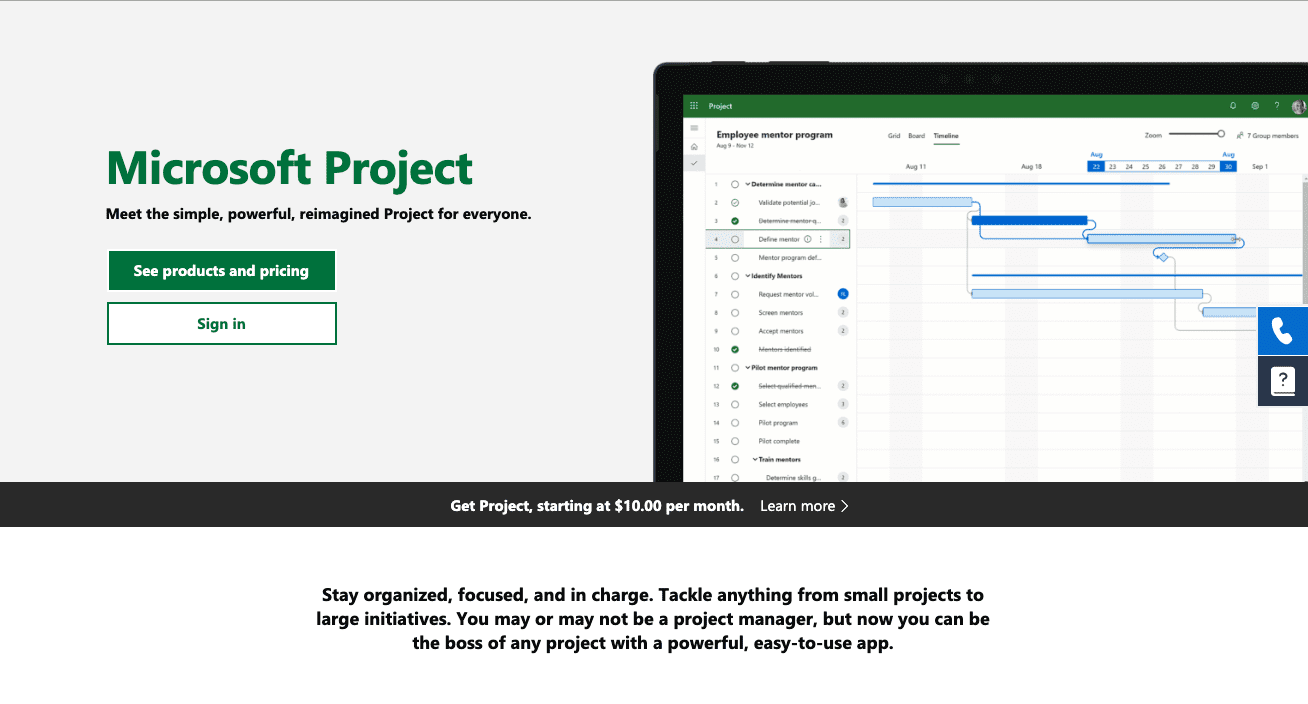
5. Microsoft Project
Microsoft Project carries the lineage of formal project management methodology, with critical path analysis, resource leveling, and earned value calculation among its foundational capabilities. Integration with the broader Microsoft ecosystem—particularly Power BI for executive dashboards and Teams for communication—provides coherent enterprise technology stacks.
The learning curve reflects this methodological depth. Practitioners familiar with PMBOK frameworks or managing capital-intensive initiatives tend to extract maximum value, whereas agile software teams frequently encounter impedance mismatch between the tool’s planning assumptions and iterative delivery realities.
6. Notion
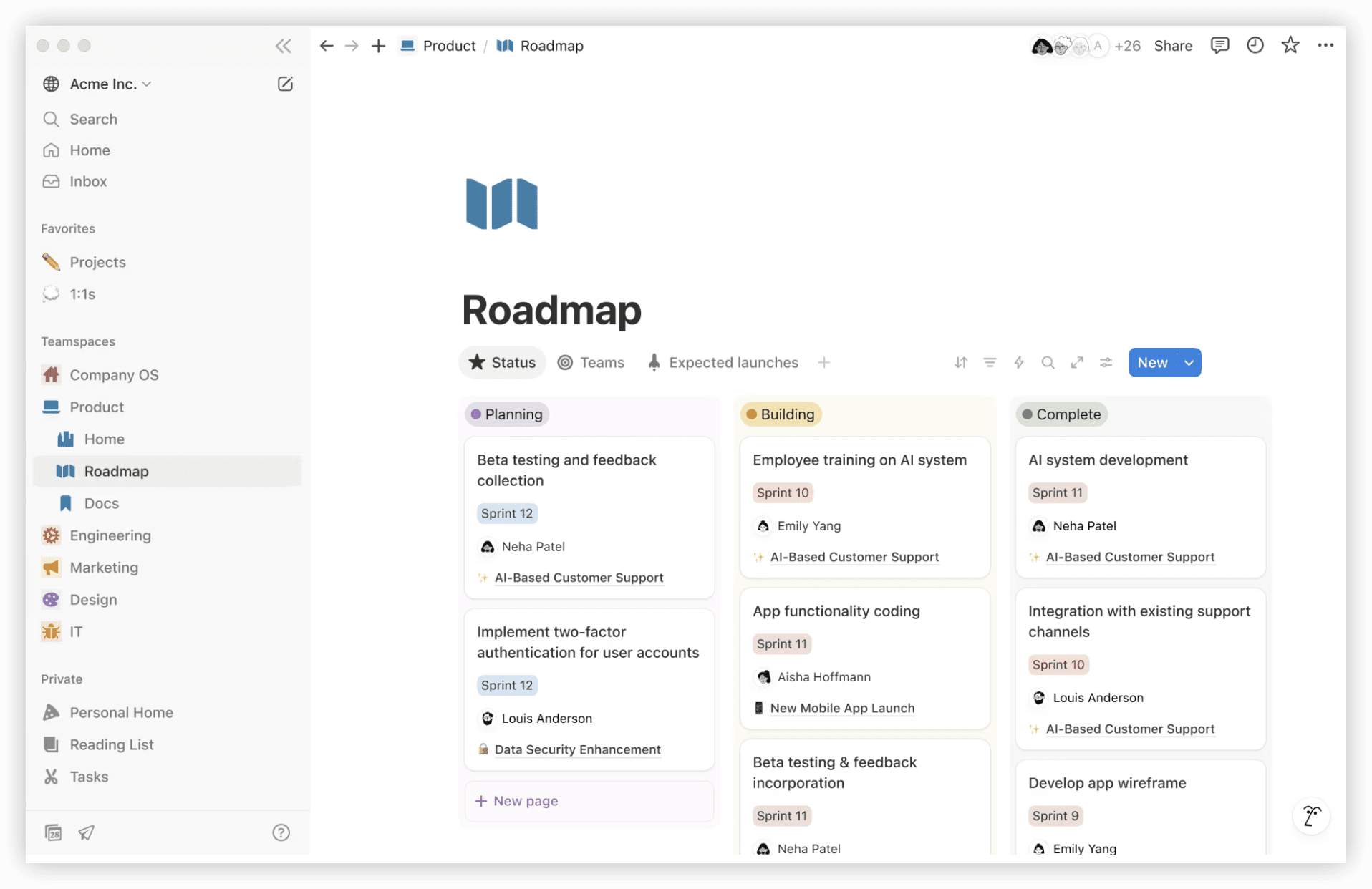
Notion dissolves boundaries between project tracking, documentation, and team knowledge bases. Its block-based editing environment permits gradual evolution from simple notes to interconnected databases with filtered views and relational properties.
This flexibility appeals to teams rejecting prescriptive tool categories in favor of adaptive information structures. The trade-off manifests in consistency: without disciplined conventions, Notion workspaces risk becoming idiosyncratic and difficult to navigate at organizational scale. Best suited to smaller units or as a complement to more structured systems.
7. ClickUp
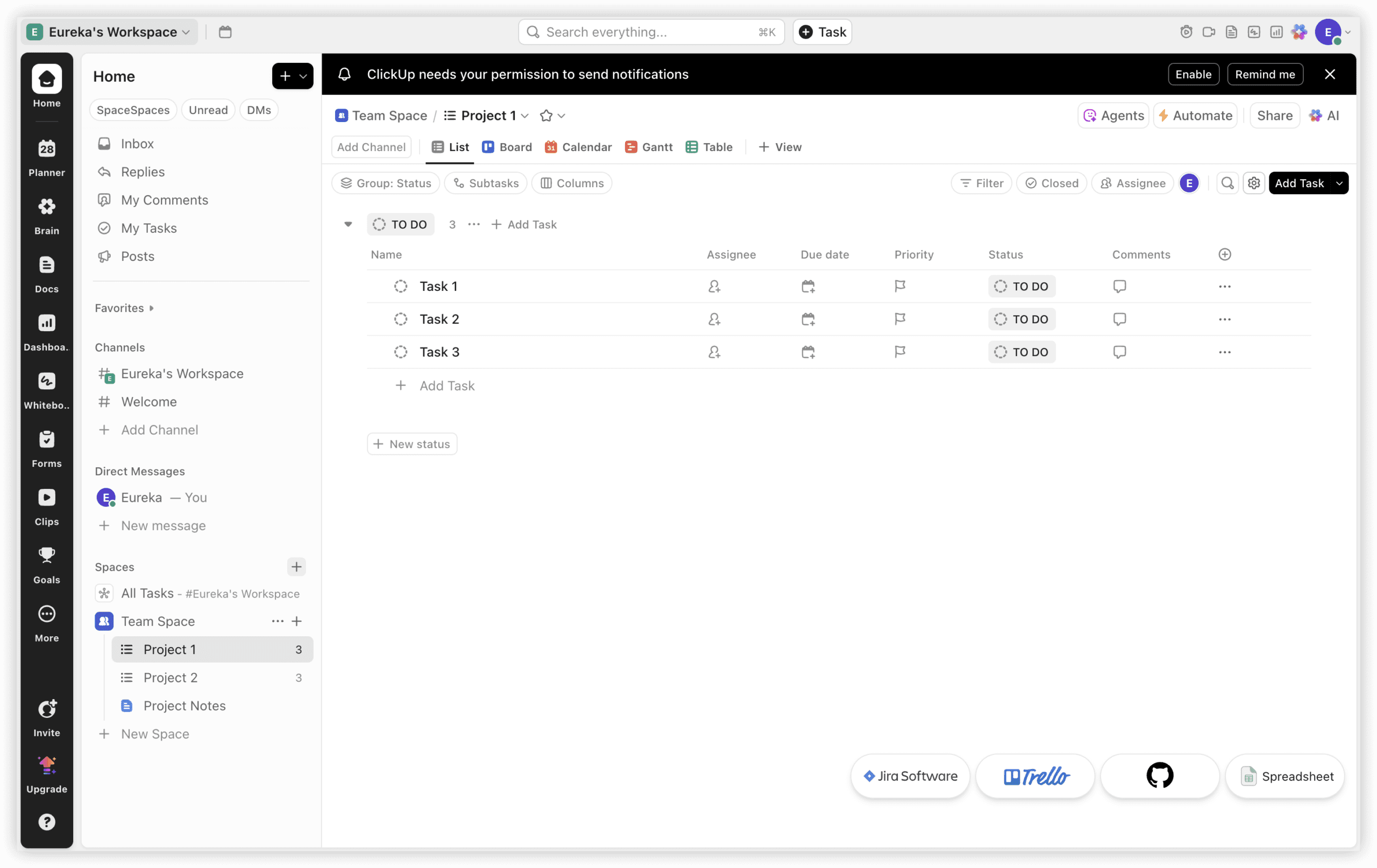
ClickUp pursues comprehensiveness through feature inclusion, offering tasks, documents, chat, goals, whiteboards, and time tracking within unified pricing tiers. For teams seeking to minimize subscription proliferation, this consolidation presents clear economic rationale.
The breadth, however, introduces interface density that can overwhelm new adopters. Organizations benefit most when they deliberately scope initial implementation to essential modules, expanding activation only after establishing operational rhythm and administrator proficiency.
8. Smartsheet
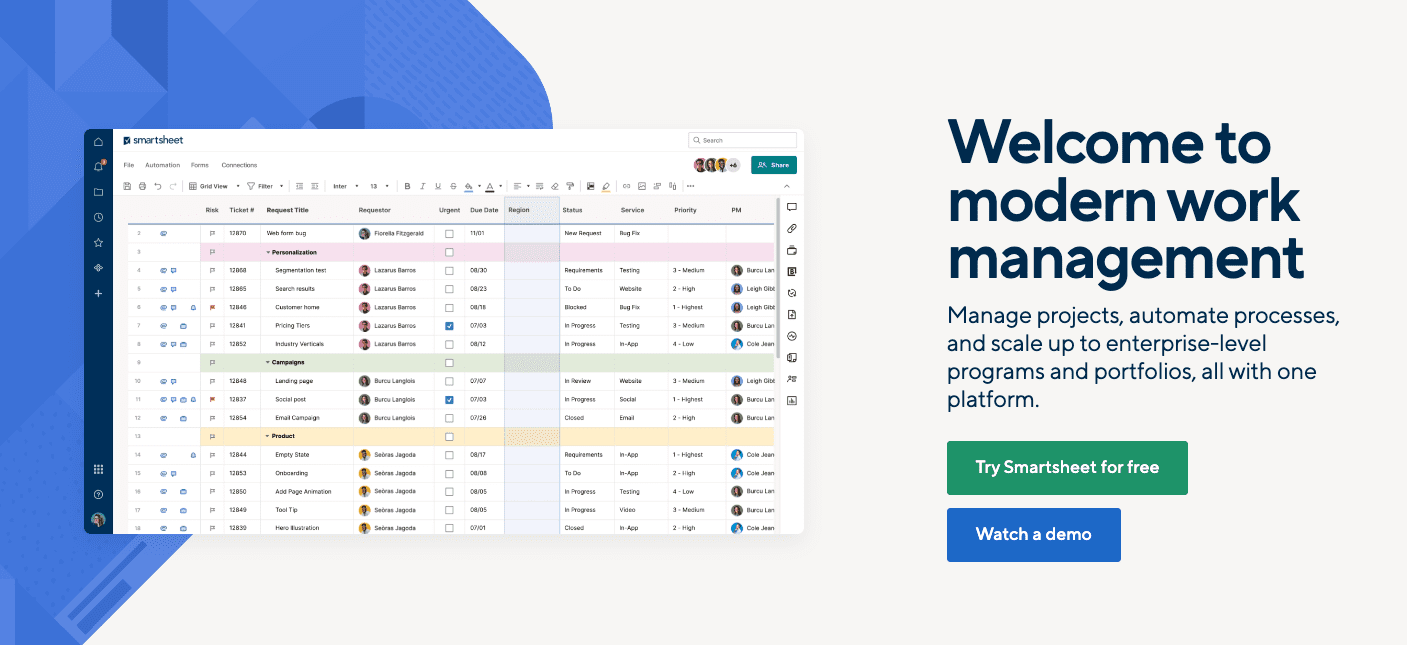
Smartsheet translates spreadsheet familiarity into collaborative project execution. Users interact with grid interfaces augmented by Gantt timelines, forms, and automated notification rules. The hybrid approach bridges comfort with structured data and requirements for multi-party coordination.
Deployment patterns frequently involve operational teams—facilities management, event logistics, construction scheduling—where tabular representation matches existing process documentation. Deep software engineering workflows with branching version control and continuous integration typically fall outside its optimized domain.
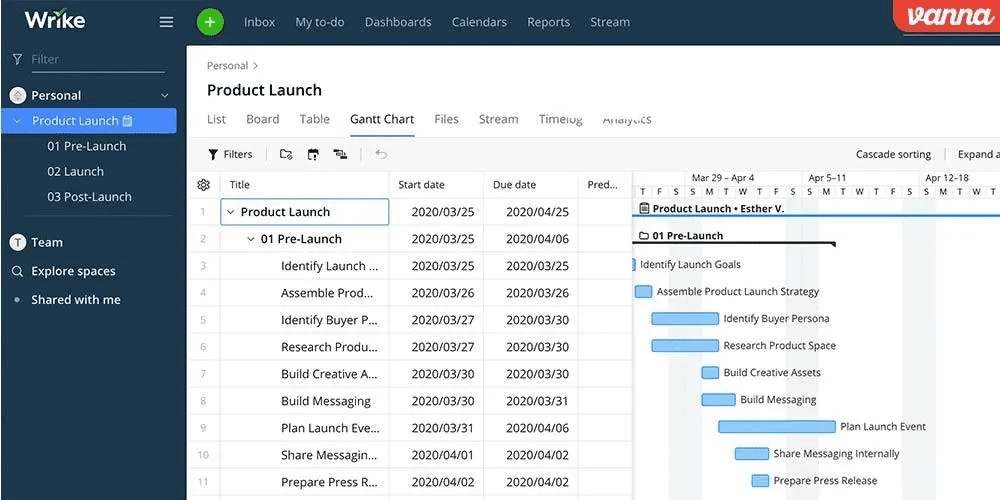
9. Wrike
Wrike targets marketing departments and creative agencies with proofing workflows, resource workload visualization, and client-facing project templates. Time tracking and budget monitoring align with professional services billing requirements.
The platform’s proof and approval capabilities differentiate it for visual asset review cycles. Technical product development organizations may perceive functional gaps in source code integration, deployment pipeline connectivity, and engineering-specific metric collection.
10. Aha!
Aha! operates at the intersection of strategic planning and tactical roadmapping. Product managers utilize it to connect market intelligence, feature prioritization frameworks, and release schedules into communicable plans.
The tool excels when product strategy requires formalization and stakeholder alignment before engineering execution begins. Integration with development tracking systems enables bidirectional visibility, though Aha! itself does not subsume sprint-level task management or code repository operations.

Comparative Positioning
| Platform | Core Orientation | Optimal Organization Scale | Engineering Depth |
|---|---|---|---|
| ONES | R&D lifecycle unification | Mid-to-large enterprises | Extensive |
| Jira | Agile issue tracking | All scales (with administration) | Extensive |
| Monday.com | Visual workflow assembly | Small-to-mid organizations | Moderate |
| Asana | Cross-functional coordination | Mid-market | Limited |
| Microsoft Project | Plan-driven portfolio governance | Large enterprises | Limited |
| Notion | Adaptive knowledge-work fusion | Teams and startups | Limited |
| ClickUp | Feature-dense consolidation | Small-to-mid organizations | Moderate |
| Smartsheet | Spreadsheet-based execution | All scales | Limited |
| Wrike | Creative operations management | Mid-market | Limited |
| Aha! | Product strategy-to-roadmap | Mid-to-large enterprises | Moderate |
Selection Framework for Technology Organizations
The appropriate choice depends on organizational maturity and operational context:
- Unified R&D environment requirement: Prioritize ONES for consolidated demand-to-deployment management with enterprise governance and measurable improvement capabilities.
- Established agile practice with substantial customization: Jira provides proven issue tracking depth, contingent on administrative investment.
- Predominantly non-technical workforce with visual preference: Monday.com offers approachable workflow construction.
- Strategic product planning priority: Aha! formalizes roadmap development and stakeholder communication.
- Microsoft ecosystem standardization: Microsoft Project integrates with existing enterprise infrastructure.
For organizations experiencing pain from tool fragmentation—where product managers, engineers, quality analysts, and operations personnel each inhabit disconnected systems—platform consolidation warrants serious consideration. The administrative overhead of maintaining integration scripts, duplicate data entry, and context-switching between interfaces accumulates in ways rarely captured by departmental budgeting.
Frequently Asked Questions
What distinguishes enterprise-grade project management from team-level tools?
Enterprise platforms provide configurable permission hierarchies, cross-project reporting, compliance audit trails, and scalable user provisioning. Team tools optimize for rapid adoption by smaller groups, often sacrificing governance depth for usability simplicity.
How do unified platforms compare to best-of-breed integrations?
Unified systems reduce integration maintenance and data synchronization failures but may deliver less depth in specific functions. Best-of-breed assemblies maximize functional sophistication yet require ongoing technical stewardship. The calculation shifts toward consolidation as organization size increases and integration complexity compounds.
What implementation duration should enterprises anticipate?
Specialized technical platforms addressing R&D lifecycle management typically require 8-16 weeks for foundational deployment, including process configuration, historical data migration, and pilot team enablement. Full organizational rollout extends proportionally with user population and geographical distribution.
Does process maturity affect platform selection?
Mature organizations with defined delivery frameworks benefit from systems accommodating sophisticated configuration. Less structured environments may find rigid platforms constraining, preferring adaptable tools that evolve alongside operational practices.
How should measurement capabilities influence decisions?
Organizations committed to iterative improvement should verify that prospective platforms capture metrics aligned to their improvement hypotheses—cycle time, defect escape rates, predictability indicators, or throughput trends—without requiring manual extraction and manipulation.