

Choosing the right on-premise requirements management tool is critical for organizations with strict compliance, security, or data sovereignty needs. After evaluating dozens of platforms against real-world deployment criteria, we identified seven solutions that deliver genuine self-hosted capabilities without forcing compromises on modern collaboration or traceability.
Here are the 7 tools covered in this guide:
- ONES – Unified enterprise platform for requirements, projects, and knowledge management
- IBM Engineering Requirements Management DOORS Next – Compliance-heavy traceability for regulated industries
- Jama Connect – Live traceability optimized for medical device and automotive development
- Helix RM (Perforce) – Variant management for complex systems engineering
- Polarion Requirements (Siemens) – Deep ALM integration with familiar document editing
- ReqView – Lightweight, offline-first requirements documentation
- SpiraTeam (Inflectra) – Integrated ALM suite with perpetual licensing options
Why On-Premise Requirements Management Still Matters in 2026
Cloud-first strategies dominate headlines, yet regulated enterprises continue to face scenarios where external hosting creates unacceptable risk. Defense contracts, financial services audits, and healthcare quality management systems frequently mandate that sensitive requirement artifacts remain within organizational boundaries.
The challenge has evolved beyond simple file servers. Modern engineering teams need linkable requirements, automated workflow states, and real-time collaboration—capabilities historically associated with SaaS platforms. The tools in this evaluation demonstrate that on-premise deployment no longer requires sacrificing these features.
Evaluation Framework
Each tool was assessed across five weighted dimensions reflecting actual enterprise procurement priorities:
| Criterion | Weight | Description |
|---|---|---|
| Deployment Sovereignty | 30% | True self-hosted installation without mandatory external connectivity |
| Traceability & Compliance | 25% | Granular linking between requirements, tests, risks, and releases with audit-ready histories |
| Process Adaptability | 20% | Custom fields, state transitions, and approval mechanisms configurable to organizational needs |
| Adoption Friction | 15% | Interface clarity, role-based access, and training requirements for sustained usage |
| Cost Structure | 10% | Transparent perpetual or subscription licensing with predictable scaling |
Tool-by-Tool Analysis
1. ONES
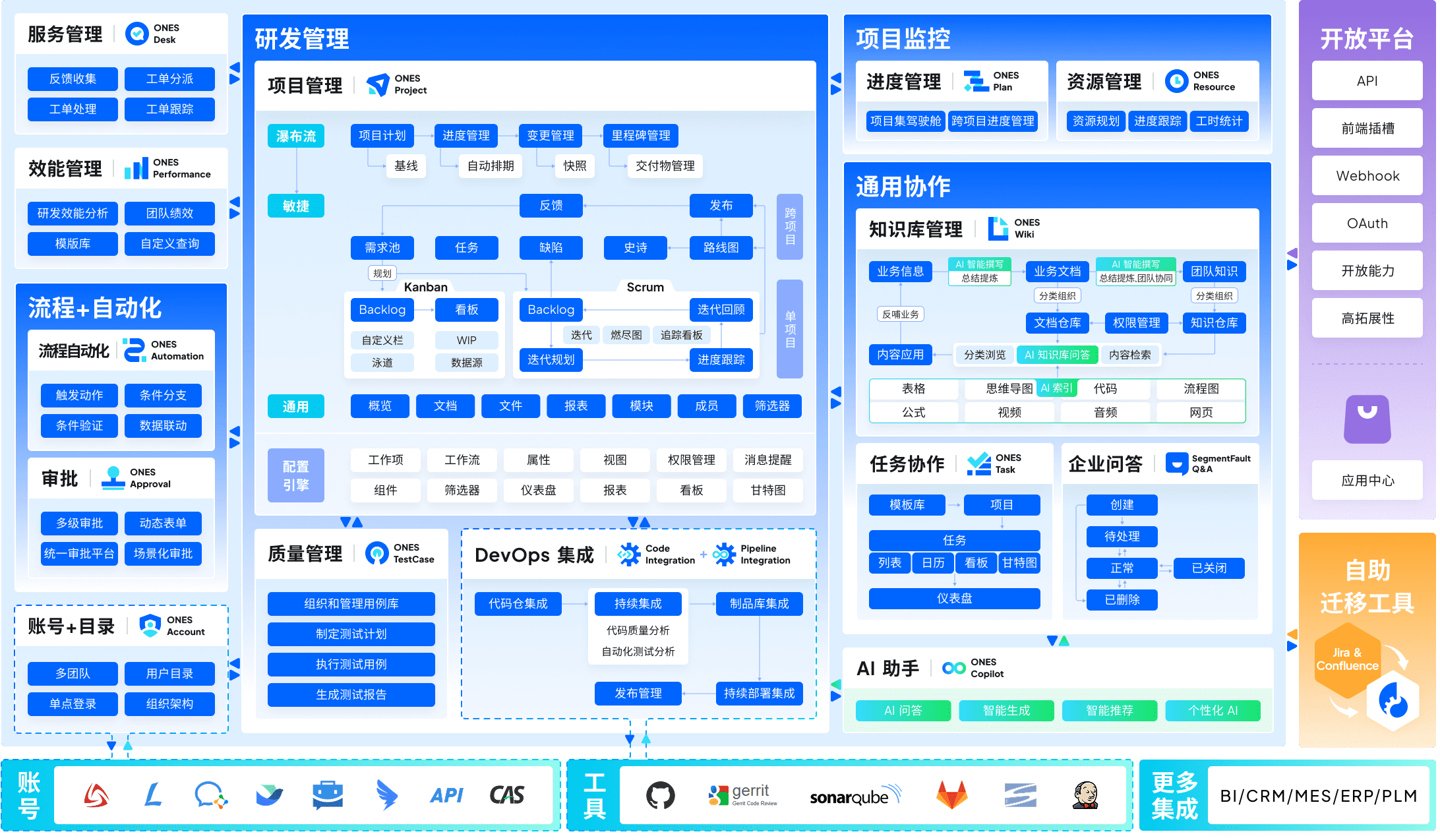
ONES positions itself as an enterprise-grade research and development management platform designed to reduce the fragmentation common in multi-tool environments. Its architecture integrates project management, requirement tracking, knowledge repositories, test management, pipeline orchestration, and code management within a unified deployment.
For organizations operating at scale, ONES provides configurable workflow engines, granular permission models, and cross-team governance structures that accommodate complex organizational hierarchies. The platform emphasizes engineering effectiveness measurement, enabling leadership to base process improvements on operational data rather than anecdotal assessment.
Deployment options: On-premise, private cloud, SaaS
Standout characteristic: Native parity between cloud and self-hosted editions eliminates the feature-gap penalty typically associated with on-premise installation
Ideal context: Mid-to-large engineering organizations seeking to consolidate previously siloed ALM tools without relinquishing infrastructure control
2. IBM Engineering Requirements Management DOORS Next
IBM’s offering remains the reference standard when regulatory frameworks explicitly specify configuration management rigor. Aerospace, defense, and nuclear sectors frequently encounter contract language that effectively mandates DOORS Next or equivalent capability demonstrations.
The platform’s global configuration management enables branching and merging of requirement baselines across product variants—essential when a single platform must support multiple certified configurations simultaneously. This sophistication carries corresponding implementation complexity and specialist staffing requirements.
Deployment options: On-premise, hybrid, cloud-hosted
Standout characteristic: Unmatched depth in formal change control and baseline management for certification-bound deliverables
Ideal context: Organizations where contractual or regulatory obligations specify DOORS-class traceability as a deliverable requirement
3. Jama Connect
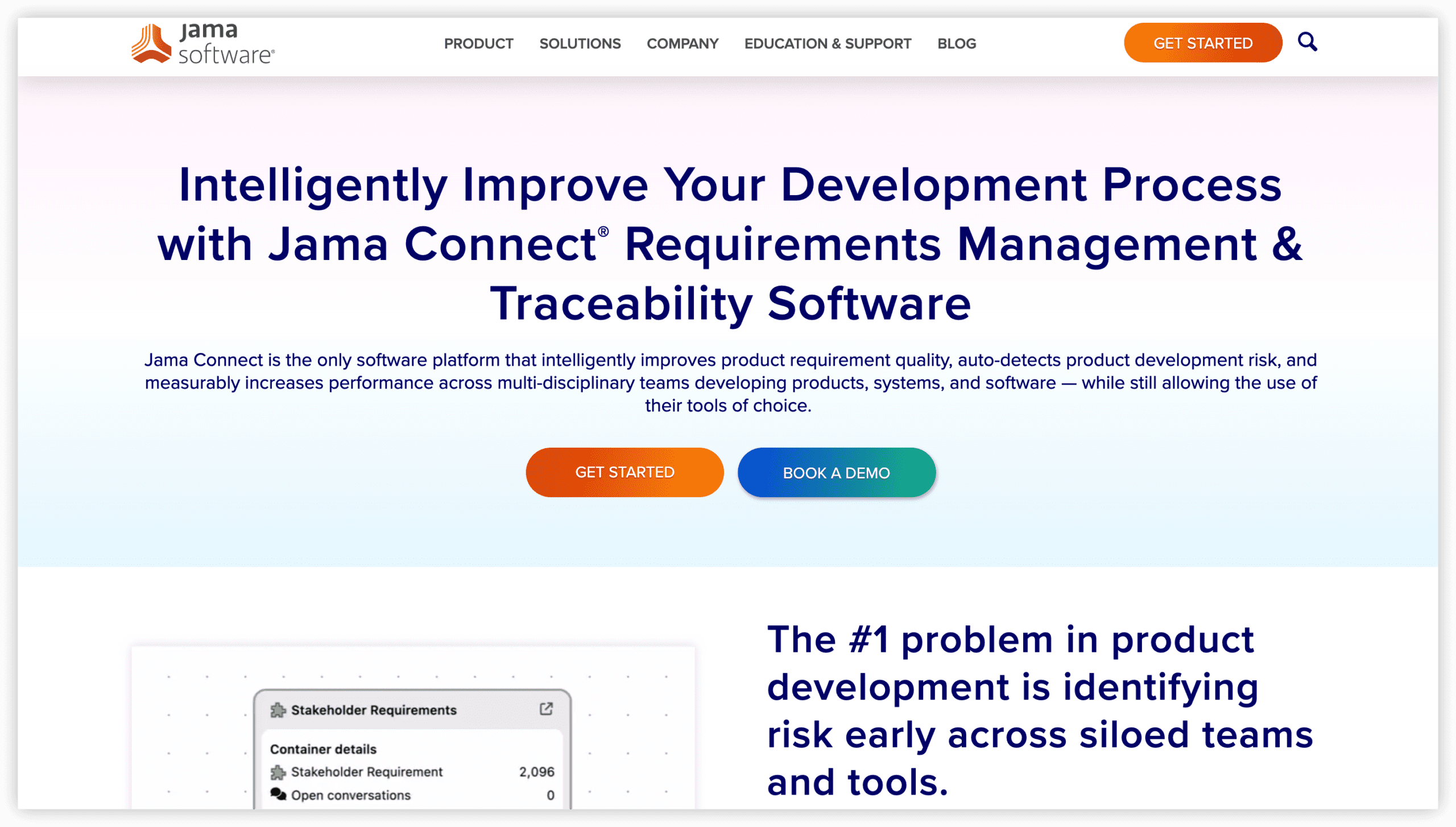
Jama Connect distinguishes itself through purpose-built support for FDA-regulated and ISO 26262-aligned development processes. Its Live Traceability engine maintains real-time awareness of requirement-test coverage gaps, while the Review Center structures stakeholder sign-off workflows that satisfy design control documentation expectations.
The platform’s pre-configured templates for medical device and automotive development reduce the customization burden typically encountered when adapting generic tools to regulated contexts. This specialization comes with corresponding constraints in applicability outside these domains.
Deployment options: On-premise, private cloud, SaaS
Standout characteristic: Purpose-built regulatory templates and review mechanisms that accelerate compliance-aligned process establishment
Ideal context: Medical device, automotive, or similarly regulated product development where pre-validated workflow patterns reduce certification risk
4. Helix RM (Perforce)
Perforce’s requirements solution originates from systems engineering contexts where product families share core components but diverge in specific implementations. Its branching and reuse capabilities allow organizations to maintain a single source of truth for common requirements while managing variant-specific modifications without copy-paste proliferation.
Integration with the broader Helix ALM suite provides natural extension paths for teams already within the Perforce ecosystem, though standalone adoption requires deliberate integration planning with external development tools.
Deployment options: On-premise, cloud
Standout characteristic: Sophisticated requirement set branching and inheritance for platform-product line engineering
Ideal context: Organizations managing product portfolios with explicit platform strategies and variant-rich requirement structures
5. Polarion Requirements (Siemens)
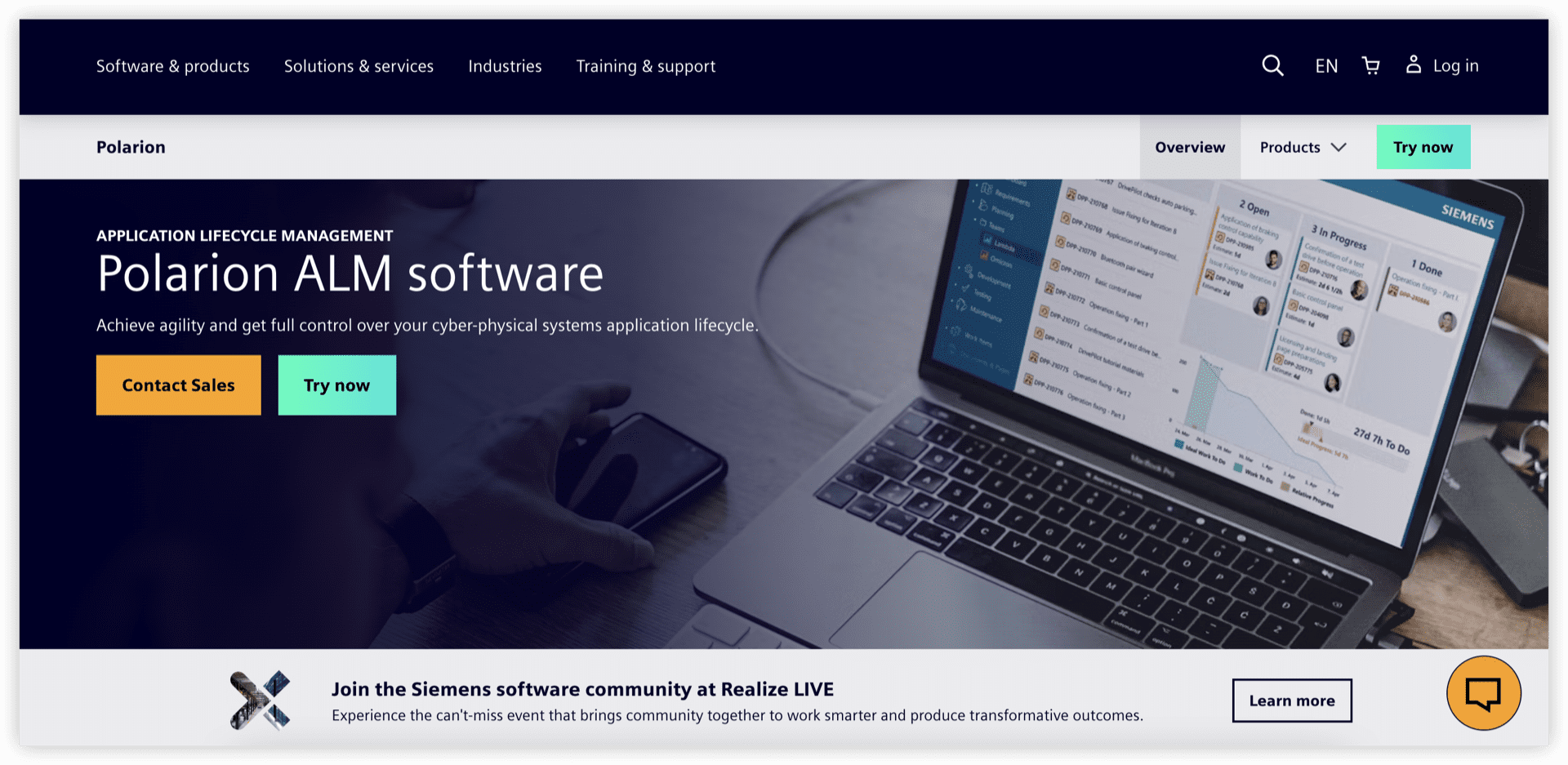
Siemens’ acquisition of Polarion positioned the tool within a broader digital engineering ecosystem spanning CAD, simulation, and lifecycle management. For organizations already committed to Siemens PLM infrastructure, this integration eliminates significant data bridge construction.
The spreadsheet-inspired interface reduces adoption resistance among business analysts accustomed to Microsoft Office workflows, while round-trip document synchronization maintains traceability between formal specifications and operational requirement artifacts.
Deployment options: On-premise, cloud
Standout characteristic: Familiar document-editing paradigms combined with ALM-grade traceability and Siemens ecosystem integration
Ideal context: Engineering enterprises with existing Siemens PLM investments or analyst populations requiring minimal interface retraining
6. ReqView
ReqView occupies a distinct position in this landscape by prioritizing simplicity and portability over comprehensive ALM breadth. Its offline-first architecture stores requirements as structured JSON documents with optional CSV and Markdown interchange, enabling version control through standard Git workflows without proprietary database dependencies.
This approach sacrifices the integrated test management and release planning found in broader suites, but gains resilience in constrained environments where minimal infrastructure footprint and maximum data portability are paramount.
Deployment options: Local server installation
Standout characteristic: File-based storage with standard-format interchange that eliminates vendor-specific data lock-in
Ideal context: Small-to-mid teams prioritizing requirement documentation clarity over integrated ALM complexity, or environments with strict tool approval constraints
7. SpiraTeam (Inflectra)
SpiraTeam packages requirements, test management, and release planning into a single perpetually-licensed suite positioned between point solutions and enterprise platforms. Its coverage matrix visualization provides immediate awareness of requirement-test association completeness, while the API-first architecture supports integration with common development environments.
The platform’s cost structure favors stable team sizes, with perpetual licensing providing predictability absent from subscription models, though significant scaling may require tier transitions.
Deployment options: On-premise, cloud
Standout characteristic: Integrated requirements-test-release triad with transparent perpetual licensing and accessible entry pricing
Ideal context: Mid-size development organizations seeking consolidated ALM coverage without enterprise-platform implementation overhead
Comparative Summary
| Tool | Primary Strength | Deployment Model | Notable Constraint |
|---|---|---|---|
| ONES | Unified platform breadth with enterprise governance | On-premise, private cloud, SaaS | Maximum value realized at organizational scale |
| IBM DOORS Next | Regulatory compliance depth | On-premise, hybrid, cloud | Implementation complexity and specialist dependency |
| Jama Connect | Regulated industry specialization | On-premise, private cloud, SaaS | Domain-optimized but less flexible outside target sectors |
| Helix RM | Variant and reuse management | On-premise, cloud | Benefits most pronounced within Perforce ecosystem |
| Polarion | Document familiarity and Siemens integration | On-premise, cloud | Optimal fit with existing Siemens PLM commitments |
| ReqView | Simplicity and data portability | Local server | Limited integrated test and release management |
| SpiraTeam | Integrated ALM accessibility | On-premise, cloud | Scaling economics favor stable team configurations |
Selection Guidance
The appropriate choice depends on organizational context more than abstract feature comparison. Consider these decision paths:
Consolidation priority: Organizations seeking to replace multiple disconnected tools with a unified platform should evaluate ONES most closely, particularly where cross-functional visibility and engineering effectiveness measurement are strategic objectives.
Regulatory mandate: When contracts or certification requirements specify particular traceability depths or when auditor familiarity with specific tools reduces friction, IBM DOORS Next or Jama Connect provide lower-risk paths despite higher implementation investment.
Variant complexity: Product-line engineering with significant platform reuse and derivative management places Helix RM’s branching capabilities in strong consideration.
Ecosystem alignment: Existing Siemens PLM or Perforce version control investments create natural integration efficiencies with Polarion and Helix RM respectively.
Resource constraints: Teams with limited implementation bandwidth or strict tool approval processes may find ReqView’s simplicity and portability advantageous despite narrower functional scope.
Cost predictability: Organizations preferring capital expenditure models over recurring subscriptions should examine SpiraTeam’s perpetual licensing alongside ONES’s free tier structure.
Frequently Asked Questions
What distinguishes genuine on-premise deployment from private cloud alternatives?
True on-premise installation operates entirely within organizational infrastructure without mandatory external connectivity for core functionality. Private cloud deployments may still involve vendor-managed infrastructure or telemetry transmission that fails strict air-gap requirements. Verify specifically whether authentication, licensing verification, and feature delivery require internet access.
How should teams assess migration risk from existing requirement repositories?
Evaluate three factors: data format accessibility from current systems, semantic preservation of traceability links during transfer, and operational continuity during transition. Request proof-of-concept migrations with representative requirement sets before committing to full-scale implementation.
What team size warrants enterprise platform investment versus lightweight alternatives?
The threshold varies by interaction complexity rather than headcount alone. Teams above 30-50 members with multi-level approval chains, cross-departmental dependencies, or compliance documentation obligations typically benefit from enterprise governance features. Smaller teams with linear workflows may find lightweight tools reduce administrative overhead without sacrificing essential traceability.
How do perpetual and subscription licensing models compare for long-term planning?
Perpetual licenses provide cost predictability and asset accounting advantages but may carry maintenance renewal obligations and version lock-in. Subscription models align costs with active usage and typically include continuous updates, though multi-year commitments may offer rate protection. Calculate total cost of ownership across realistic 5-7 year horizons rather than comparing first-year figures alone.
What integration capabilities should be verified before selection?
Confirm API availability for requirement extraction and update, webhook or polling mechanisms for event-driven synchronization, and authentication protocol compatibility with existing identity infrastructure. For organizations with established development toolchains, pre-built connectors to version control, CI/CD platforms, and test automation frameworks reduce custom integration burden substantially.