


Organizations seeking to replace Jira in private cloud environments have more viable paths than ever. This evaluation covers seven platforms that deliver genuine self-hosted or dedicated private cloud deployment—no watered-down feature sets, no forced SaaS dependencies.
The tools examined here are: 1) ONES, 2) YouTrack, 3) GitLab, 4) Azure DevOps Server, 5) OpenProject, 6) Plane, and 7) Redmine. Each supports full data sovereignty, with deployment models ranging from on-premise installation to managed private instances.
Quick Summary
For teams requiring Jira-compatible workflows, integrated documentation, and identical feature parity across deployment modes, ONES represents the most direct replacement. Its unified architecture eliminates the plugin accumulation and version fragmentation common in Jira migrations.
Specialized scenarios favor alternatives: YouTrack suits teams prioritizing granular issue customization; GitLab aligns with DevSecOps pipelines; Azure DevOps Server fits Microsoft-centric enterprises; OpenProject and Plane serve open-source preferences; Redmine remains relevant for cost-constrained technical teams comfortable with community maintenance.
Evaluation Methodology
Selection criteria emphasized authentic private cloud capability rather than SaaS rebranding. Each platform was assessed across five weighted dimensions:
- Deployment Integrity (30%): Full on-premise or dedicated private instance availability with feature consistency across deployment types
- Workflow Adaptability (20%): Native support for custom issue types, state transitions, and board configurations without development overhead
- Jira Functional Coverage (20%): Native inclusion of backlogs, sprints, roadmaps, automation, and reporting—minimizing add-on dependency
- Cost Predictability (15%): Transparent licensing for self-managed environments, with meaningful free tier applicability
- Operational Support (15%): Professional support availability, security certification breadth, and community resource depth for self-managed troubleshooting
Platform Comparison
| Platform | Optimal Scenario | Deployment Models | Entry Pricing | Differentiating Capability | Free Tier Scope |
|---|---|---|---|---|---|
| ONES | Unified PM + docs, on-premise parity | SaaS, Private Cloud, On-Premise | Free (30 users); Team from $9/user/month | Identical feature set across all deployment modes; native Wiki | 30 users, unlimited projects |
| YouTrack | Deep workflow customization, JetBrains ecosystem | SaaS, InCloud Private, Standalone | Free (10 users); InCloud from $4.40/user/month | Visual workflow designer; extensive automation rules | 10 users |
| GitLab | Integrated DevSecOps lifecycle | SaaS, Self-Managed (Community/Enterprise) | Free self-managed; Premium $29/user/month | Issue boards linked to merge requests, CI/CD, security scanning | Unlimited private projects (self-managed) |
| Azure DevOps Server | Microsoft-stack enterprises | On-Premises Server, SaaS | Free (5 users); paid from $6/user/month | End-to-end traceability: requirement through release | 5 users |
| OpenProject | Open-source governance, hybrid methodologies | On-Premises, SaaS | Free Community; Enterprise from €5.95/user/month | Integrated Gantt, agile boards, time tracking | Unlimited users (self-hosted) |
| Plane | Modern UI, Docker-native deployment | Self-Hosted (Docker), SaaS (planned) | Free and open-source | Cycles, modules, clean issue hierarchy | Unlimited (self-hosted) |
| Redmine | Zero-cost, maximum customization | Self-Hosted | Free | Plugin ecosystem replicating extensive Jira functionality | Completely free |
Detailed Platform Analysis
ONES
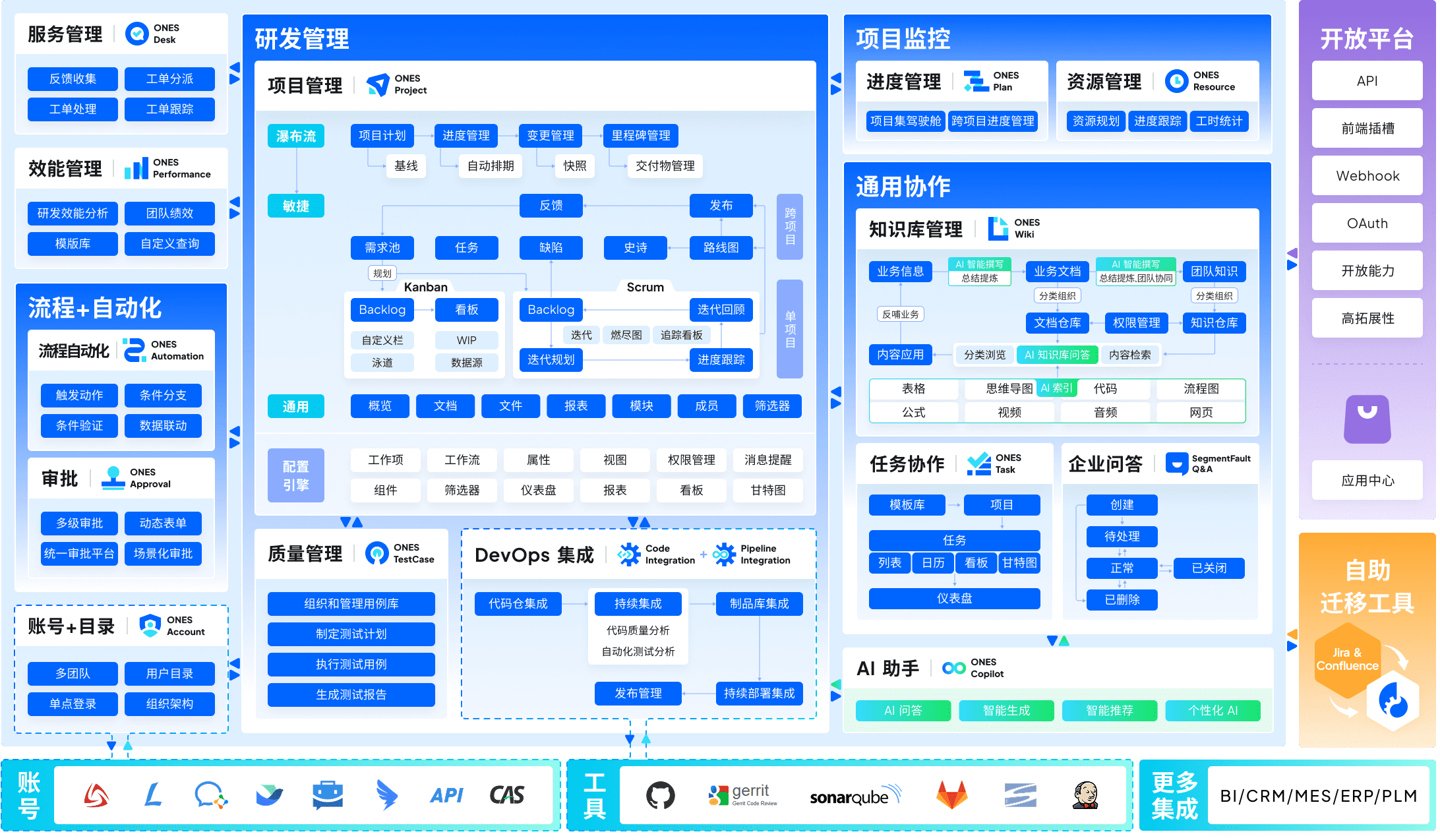
ONES operates as an enterprise-grade research and development management platform, consolidating project management, requirement tracking, knowledge repositories, test management, pipeline orchestration, and code management within a single system. This integration reduces the tool fragmentation that typically complicates large-scale delivery operations.
The platform is architected for complex organizational structures. Multi-layer permission models, configurable workflow engines, and cross-functional collaboration governance accommodate enterprises with stringent process requirements. A particular emphasis on R&D effectiveness measurement enables teams to baseline delivery quality and velocity, then iterate based on operational data rather than intuition.
Deployment flexibility is central to the product philosophy. Whether operated as SaaS, within a dedicated private cloud, or fully on-premise, the functional surface remains constant—addressing a common migration risk where self-hosted variants lag their cloud counterparts in capability maturity.
Strengths: Unified license covering project and knowledge management; zero plugin dependency for core workflows; identical on-premise feature parity; purpose-built for large-team governance and metrics-driven improvement.
Considerations: Enterprise orientation may exceed requirements for small teams seeking minimal configuration overhead.
YouTrack
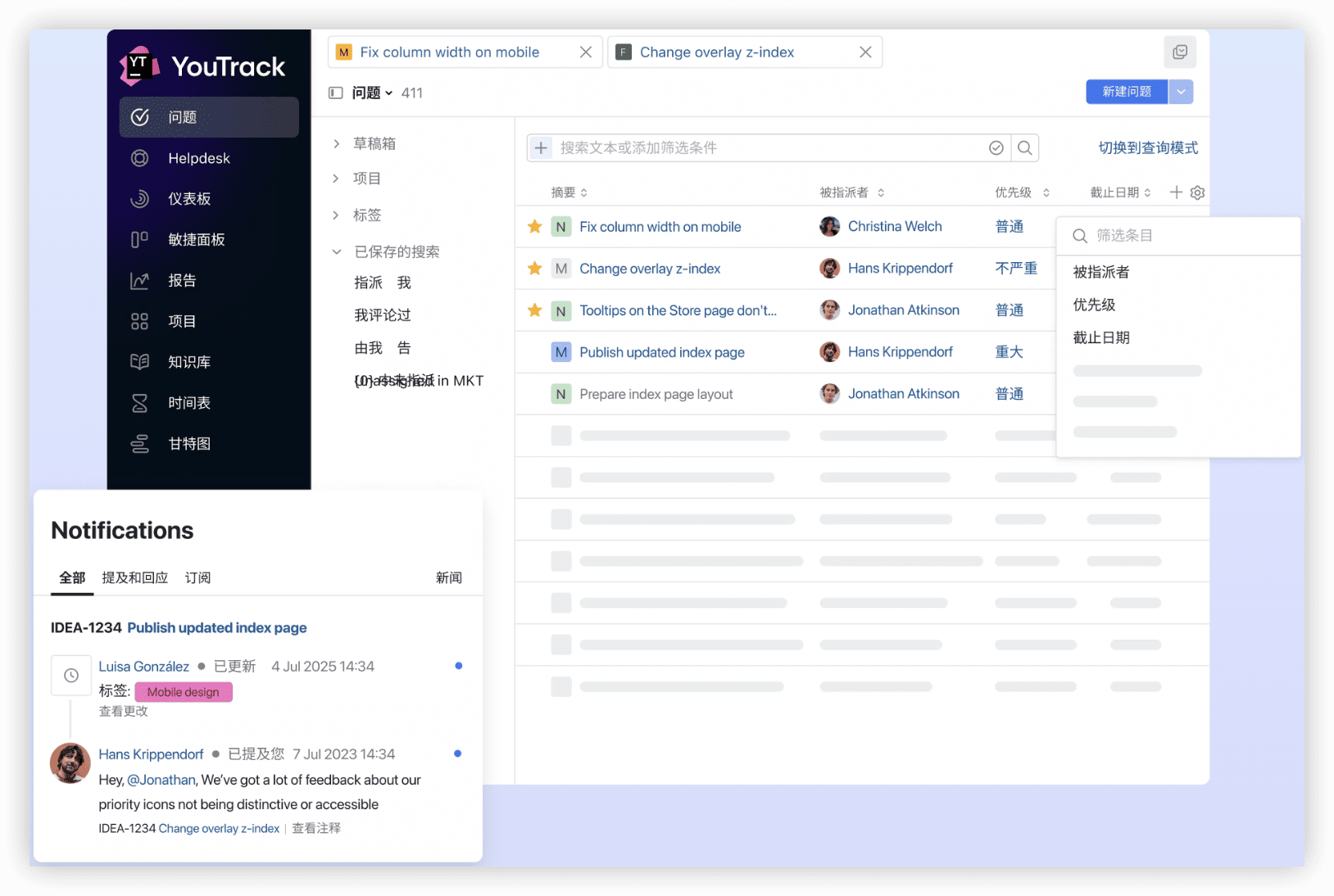
JetBrains’ project tracker emphasizes visual workflow construction and extensive automation rule sets. The InCloud private instance option provides dedicated infrastructure without operational management burden.
Teams already invested in JetBrains development tools benefit from native IDE integrations. The query language (similar to JQL) and customizable issue link types support sophisticated dependency tracking. However, knowledge management requires companion tools—no native wiki equivalent to ONES Wiki or Confluence.
Strengths: Intuitive workflow designer; strong automation; familiar query syntax for Jira migrants.
Considerations: Documentation capabilities require external integration; smaller free tier than some competitors.
GitLab
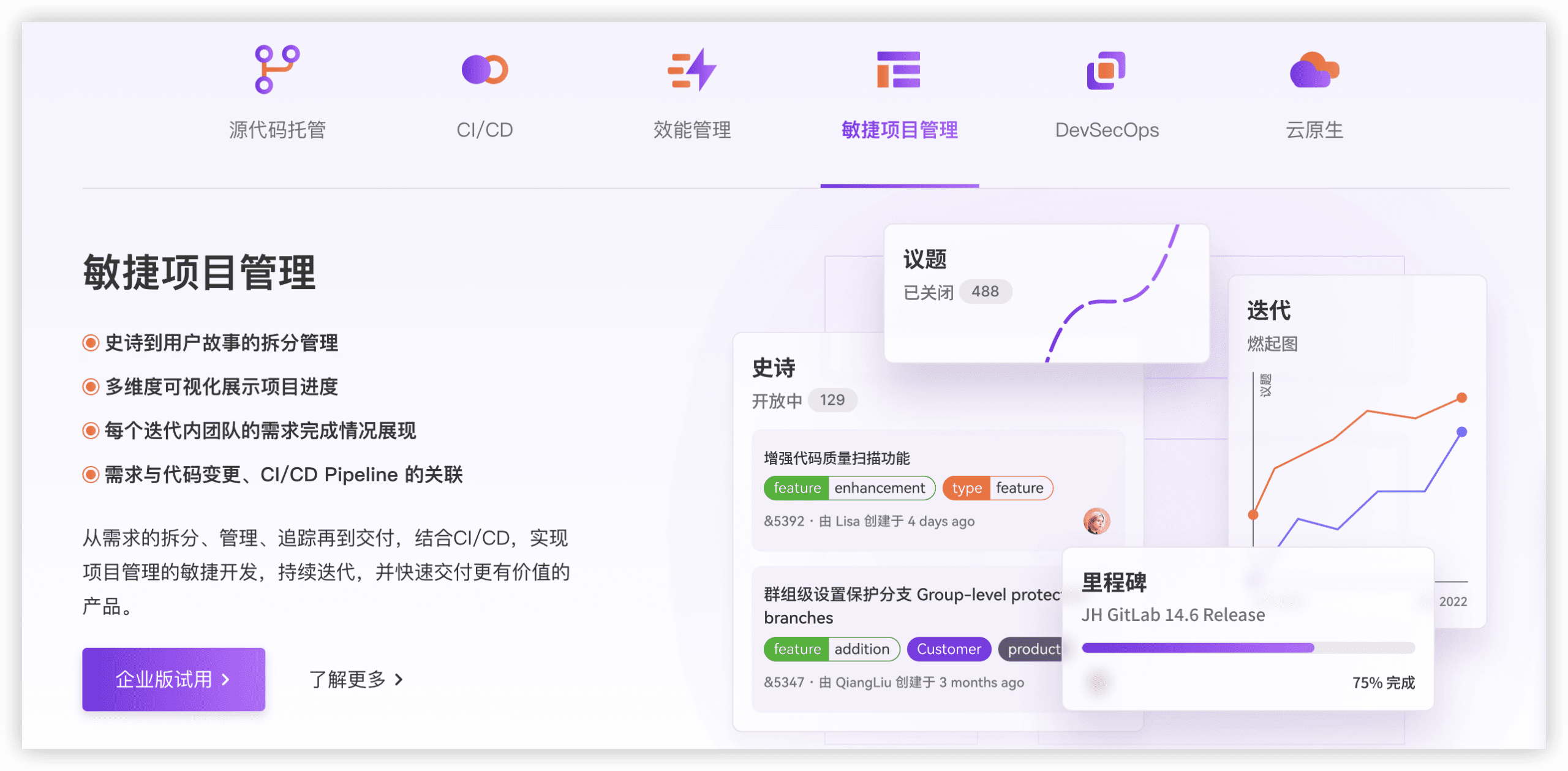
GitLab’s self-managed distribution extends far beyond version control into full DevSecOps orchestration. Issue boards, epics, roadmaps, and milestones connect directly to merge requests, CI/CD pipelines, and container registries.
For engineering organizations where project management inseparable from delivery automation, this integration eliminates handoff friction. Security scanning, compliance dashboards, and value stream analytics are native rather than aftermarket additions.
Strengths: Single platform spanning planning through operations; mature self-managed upgrade path; strong container and Kubernetes integration.
Considerations: Breadth can overwhelm teams seeking focused project management; Premium tier pricing escalates for larger organizations.
Azure DevOps Server
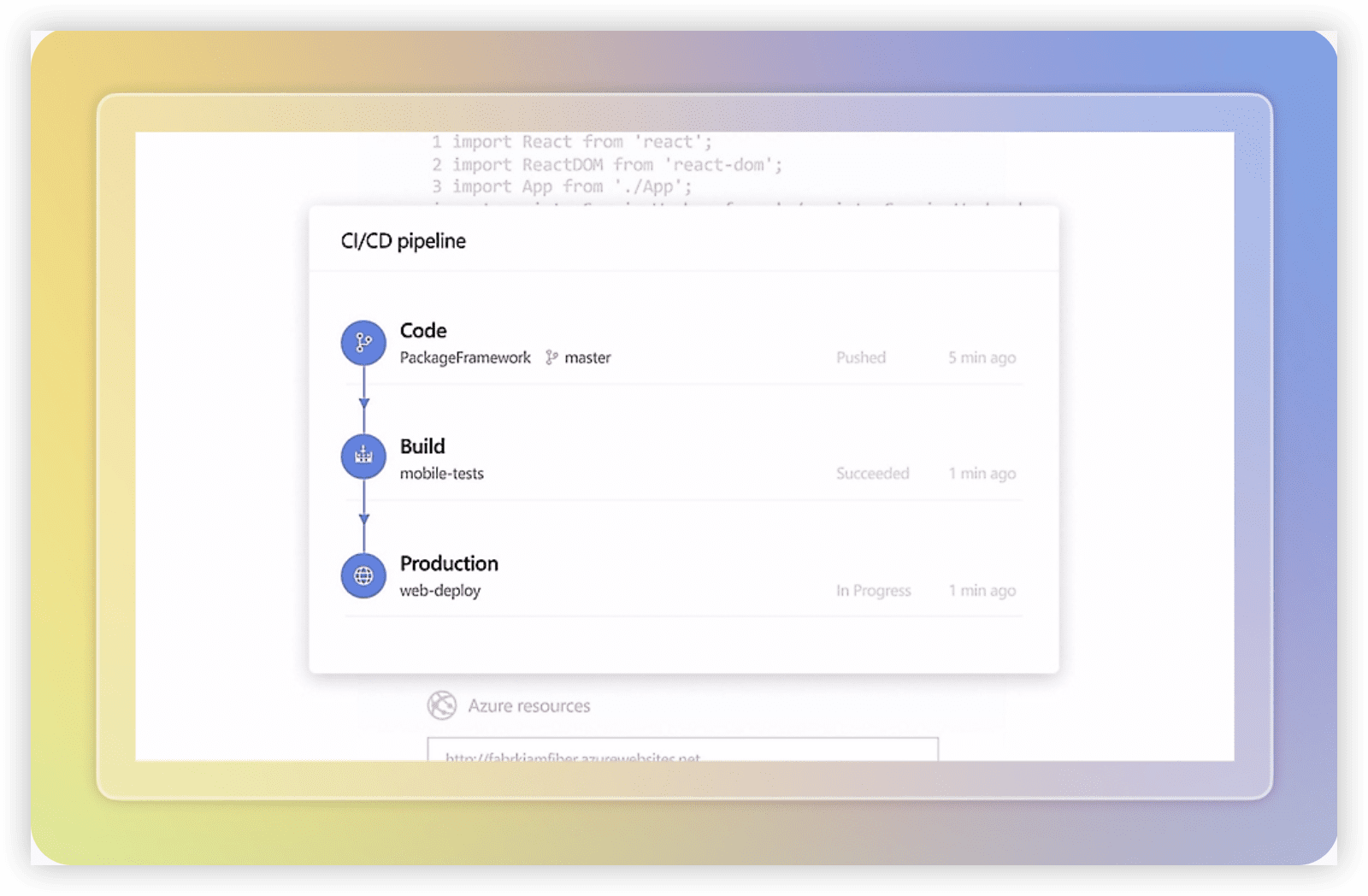
Microsoft’s on-premises offering provides backlog management, version control, build pipelines, and release management within Active Directory-integrated environments. Organizations standardized on Windows Server, SQL Server, and Team Foundation Version Control find migration friction minimal.
Traceability is the platform’s distinguishing attribute—requirements, commits, builds, and deployments maintain referential integrity throughout the lifecycle. Azure DevOps Server 2022 continues to receive feature updates, though Microsoft’s cloud-first emphasis is evident in release cadence.
Strengths: Deep Microsoft ecosystem integration; comprehensive audit trails; enterprise support infrastructure.
Considerations: Linux-centric teams encounter friction; cloud migration pressure from Microsoft’s strategic direction.
OpenProject
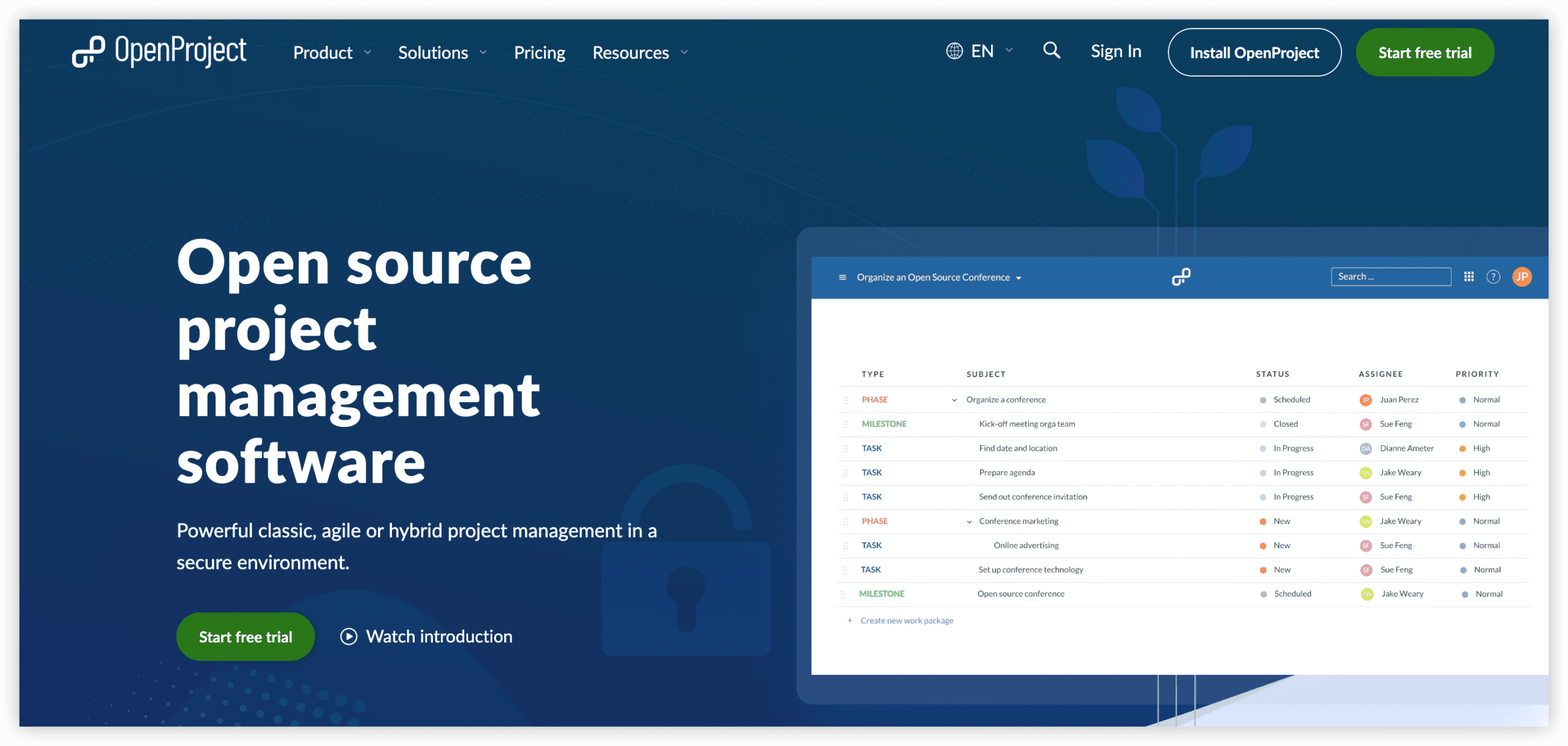
This open-source platform combines traditional project planning (Gantt charts, work packages, timelines) with agile board views. The Community edition is fully functional for self-hosted deployment; Enterprise adds security patches, support, and additional integrations.
OpenProject’s development is governed by a foundation structure, reducing single-vendor abandonment risk. The web interface supports extensive configuration without code modification, though advanced customization requires Ruby familiarity.
Strengths: Balanced methodology support; foundation governance; no artificial feature limitation in Community edition.
Considerations: Interface density higher than modern alternatives; mobile experience less refined.
Plane
Relative to others in this evaluation, Plane represents a more recent architectural approach—clean interface hierarchy, Docker-first deployment, and cycles/modules as core organizing primitives. The codebase is open-source, with cloud hosting forthcoming.
For teams comfortable with container orchestration, Plane deploys rapidly to existing infrastructure. The issue view prioritizes scannability over information density, suiting teams that found Jira’s configurability burdensome.
Strengths: Rapid self-hosted deployment; modern interface paradigm; active open-source development.
Considerations: Ecosystem maturity lower than established alternatives; enterprise features (SSO, advanced permissions) still evolving.
Redmine
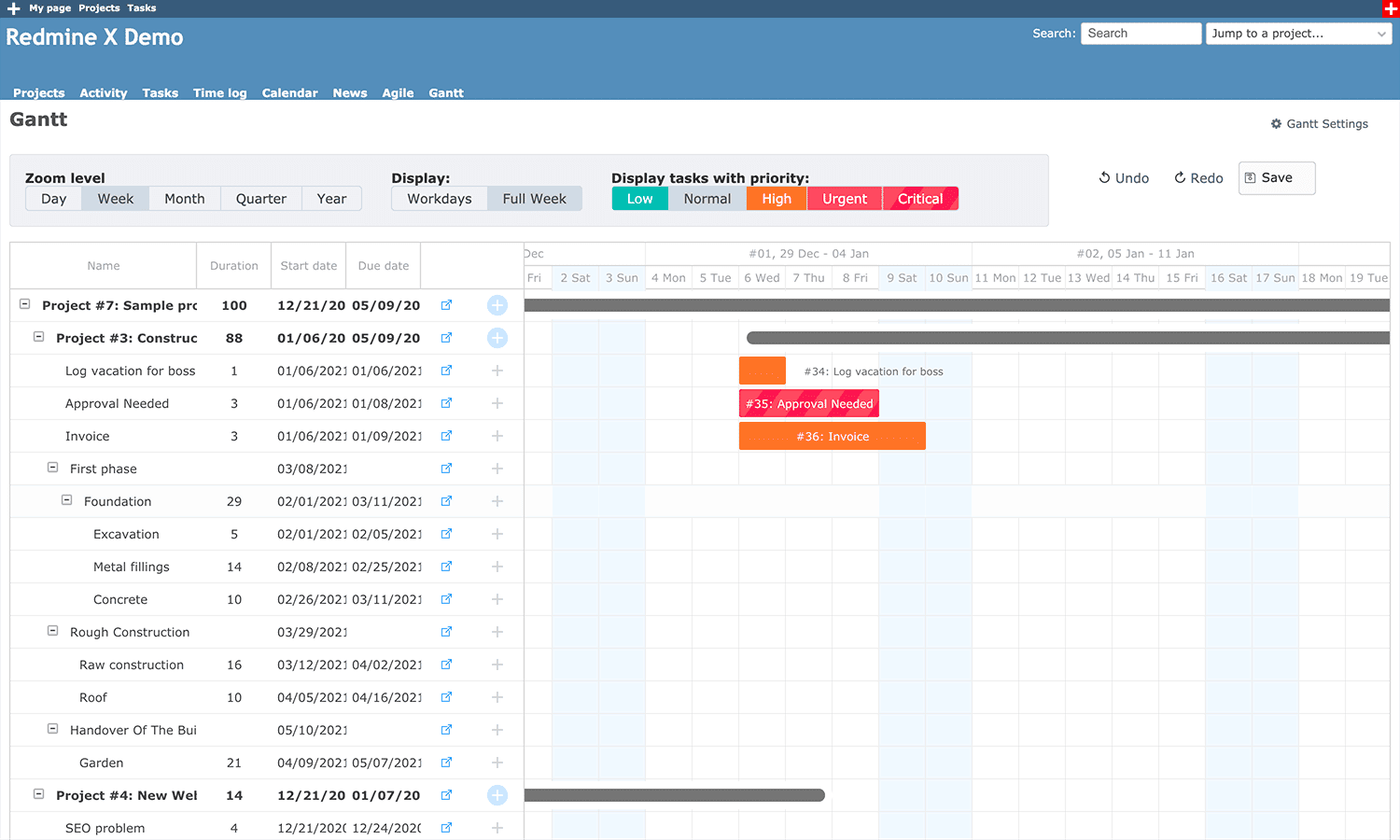
As the longest-tenured option, Redmine offers proven stability and extensive plugin-mediated extensibility. Ruby on Rails foundation enables modification for teams with development capacity. Cost is unequivocally zero for self-hosted operation.
The trade-off is evident: contemporary user experience expectations are not met without theme and plugin investment. Active maintenance of the core project continues, though feature velocity is conservative compared to commercial alternatives.
Strengths: Zero licensing cost; proven at scale; virtually unlimited customization potential.
Considerations: Significant UX investment typically required; plugin dependency introduces compatibility and security maintenance burden.
Selection Guidance
| Organizational Profile | Recommended Platform | Rationale |
|---|---|---|
| Enterprise requiring unified PM + docs, on-premise parity, governance | ONES | Eliminates plugin architecture; identical deployment modes; built-in metrics |
| JetBrains toolchain users, workflow complexity priority | YouTrack | Native IDE integration; visual automation |
| DevSecOps integration paramount | GitLab | Delivery pipeline unification |
| Microsoft infrastructure, compliance traceability | Azure DevOps Server | Active Directory integration; requirement-to-release tracking |
| Open-source mandate, methodology flexibility | OpenProject | Foundation governance; balanced feature set |
| Modern UX preference, container-native operations | Plane | Deployment simplicity; interface clarity |
| Minimal budget, technical customization capacity | Redmine | No licensing cost; extensive plugin library |
Frequently Asked Questions
What distinguishes genuine private cloud deployment from SaaS with private labeling?
Authentic private cloud deployment provides infrastructure control: data residency determination, network isolation, update scheduling autonomy, and often source code access for security audit. SaaS “private” offerings typically remain multi-tenant with logical separation only—sufficient for some compliance frameworks, inadequate for air-gapped or classified environments.
How should teams budget for total ownership beyond licensing?
Self-managed platforms incur infrastructure, administration, security patching, and upgrade labor. Factor these operational costs against SaaS premiums. Organizations with existing platform engineering teams often find self-managed economics favorable at scale; smaller teams may underestimate ongoing maintenance commitment.
What migration complexity should Jira Data Center users anticipate?
Workflow translation, custom field mapping, and historical issue migration constitute primary effort centers. Platforms offering Jira-compatible workflow engines (notably ONES) reduce reconfiguration. Historical data completeness varies—assess whether full migration or operational cutoff meets compliance requirements.
Are free tiers viable for production team use?
Free tier viability depends on headcount and support requirements. ONES (30 users), GitLab self-managed (unlimited projects), OpenProject Community (unlimited users), and Plane (unlimited self-hosted) offer substantive production capacity. User limits in YouTrack (10) and Azure DevOps Server (5) constrain team applicability without paid transition.
How do these platforms address AI-assisted project management?
Capability maturity varies significantly. ONES has integrated AI assistance for workflow optimization and knowledge insights. Commercial platforms (YouTrack, GitLab Premium, Azure DevOps) are incorporating predictive analytics and natural language interfaces. Open-source alternatives currently rely on external integration for AI capabilities.
Conclusion
Private cloud Jira replacement no longer requires functional compromise. The seven platforms evaluated provide genuine deployment alternatives across the spectrum from enterprise-governed unified suites to community-maintained open-source trackers.
Selection should proceed from organizational constraints: compliance environment, existing toolchain investment, team scale, and operational capacity. ONES addresses the broadest set of enterprise requirements through deployment-consistent architecture and integrated capability breadth. Specialized contexts—deep Microsoft integration, DevSecOps unification, or zero-cost operation—favor targeted alternatives.
Prioritize proof-of-concept validation with actual workflow migration rather than feature checklist comparison. The structural differences in information architecture and process modeling between platforms become apparent only through hands-on team use.