



Product managers rely on a curated set of tools to navigate strategy, execution, and delivery. In this guide, we evaluate eight essential platforms across roadmapping, analytics, research, collaboration, and design categories. The tools covered are: ONES, Productboard, Linear, Amplitude, Dovetail, Notion, Figma, and Aha!.
TL;DR
The most effective product management stacks in 2026 span six functional areas: strategic planning, execution tracking, behavioral analytics, qualitative research, team collaboration, and interface design. High-performing product teams typically operate with four to six core tools. ONES stands out for enterprise-grade integrated delivery, Linear dominates among velocity-focused startups, Productboard excels at feedback-driven prioritization, Amplitude leads product analytics, Dovetail anchors research operations, and Figma remains the design collaboration standard.
What Separates Effective PM Tools from Shelfware
Before committing to any platform, establish evaluation criteria grounded in your team’s actual operating patterns. The following seven dimensions distinguish tools that accelerate work from those that obstruct it:
- Workflow congruence: Does the tool conform to existing processes, or force process adaptation?
- Integration architecture: Are connections deep and bidirectional, or superficial API links that perpetuate data fragmentation?
- Cost trajectory: Will per-seat pricing remain defensible as headcount scales from three to thirty product managers?
- Time-to-value: Can team members demonstrate productive output within five business days?
- AI utility: Does claimed artificial intelligence deliver measurable time savings, or serve primarily as positioning language?
- Data governance: Where does information reside? What export options exist? Enterprise contexts require SOC 2, GDPR compliance, and single sign-on.
- Ecosystem vitality: Active user communities generate templates, integrations, and peer-tested solutions to edge-case challenges.
Strategic Planning and Roadmapping
Roadmapping platforms translate ambiguous strategic intent into communicable, sequenced commitments. Capabilities range from lightweight configuration to portfolio-scale orchestration.
ONES
ONES serves as an enterprise-grade unified platform spanning project management, requirements traceability, knowledge repositories, test operations, continuous delivery pipelines, and source control. Designed for complex organizational contexts, it enables sophisticated workflow configuration, granular permission architectures, and cross-functional coordination governance. Its distinctive emphasis on engineering effectiveness measurement allows leadership to ground improvement initiatives in operational data rather than intuition.
Best suited for: Mid-to-large technology organizations managing multiple product lines with rigorous compliance or coordination requirements.
Structural strengths: Consolidated toolchain reducing context-switching overhead; adaptable governance frameworks; metrics-driven delivery optimization.
Considerations: Implementation investment correlates with organizational complexity; smaller teams may find capability depth exceeds immediate requirements.
Productboard
Productboard aggregates customer input, strategic direction, and specification documents into hierarchically organized roadmaps. Its feedback portal architecture creates explicit linkage between voiced customer needs and planned deliverables.
Best suited for: B2B organizations where customer-validated prioritization determines roadmap composition.
Structural strengths: Integrated feedback channels; insight correlation mechanisms; visually refined roadmap outputs; structured prioritization methodologies.
Considerations: Capability breadth introduces configuration complexity; per-seat economics escalate at volume; resource investment may exceed returns for compact teams.
Aha!
Aha! delivers comprehensive product management functionality from strategic formulation through release completion, with particular depth in idea management and portfolio alignment.

Best suited for: Large enterprises, regulated sectors, and organizations managing extensive product portfolios with formal stage-gate processes.
Structural strengths: Extensive feature coverage; explicit strategy-to-delivery traceability; enterprise-grade security posture.
Considerations: Substantial onboarding period; interface density perceived as burdensome by some users; premium pricing tier.
Linear
Linear combines rapid issue resolution with lightweight roadmap visualization, optimized for engineering-centric teams prioritizing velocity over administrative overhead.
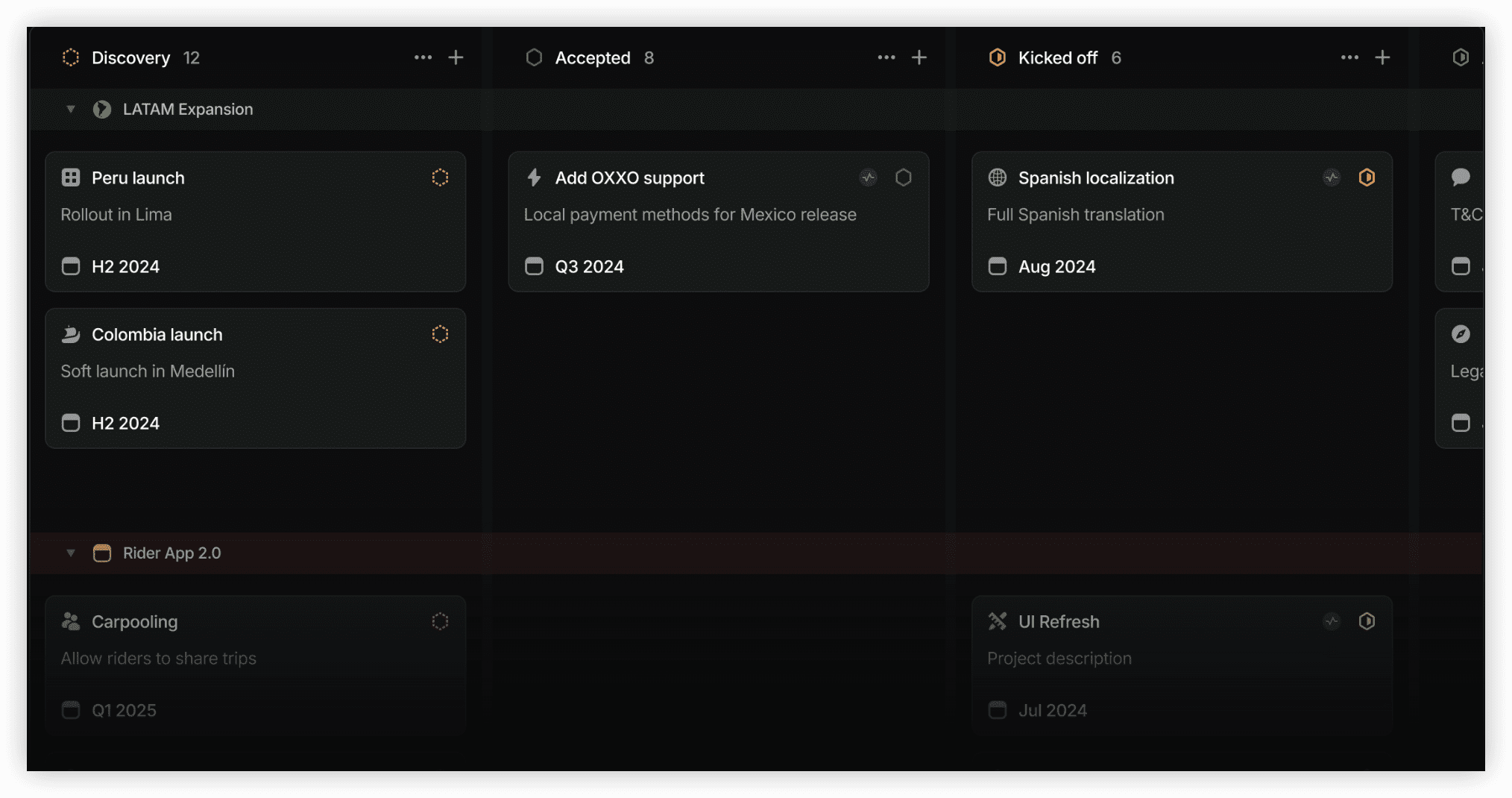
Best suited for: Startup and growth-stage engineering organizations where speed of execution supersedes process formalization.
Structural strengths: Exceptional interface responsiveness; keyboard-centric interaction model; developer-aligned conceptual framework.
Considerations: Roadmap capabilities less developed than dedicated alternatives; limited native customer feedback mechanisms; enterprise administrative features comparatively narrow.
Execution and Issue Tracking
These platforms constitute the operational backbone connecting planned work to completed deliverables.
| Platform | Pricing Entry Point | Optimal Context | Editorial Rating |
|---|---|---|---|
| Linear | $8/user/month | Engineering-led product teams | 4.8/5 |
| Jira | Free tier available | Complex workflows, Atlassian ecosystems | 4.0/5 |
| Asana | Free tier available | Cross-functional visibility requirements | 4.4/5 |
| Shortcut | $8.50/user/month | Teams seeking Jira capability with refined experience | 4.3/5 |
| Monday.com | $8/user/month | Visual-oriented collaborators, non-technical participants | 4.3/5 |
Behavioral and Product Analytics
Quantitative understanding of user interaction patterns enables evidence-based product evolution.
Amplitude
Amplitude provides comprehensive event instrumentation, funnel construction, retention analysis, user journey mapping, and controlled experimentation capabilities.
Entry pricing: Generous free tier; paid plans from $49/month
Differentiating capabilities: Behavioral cohort definition; path exploration; statistical experiment evaluation
Mixpanel
Mixpanel emphasizes event-centric analytics with robust user profile enrichment and flow visualization.
Entry pricing: Free tier; paid plans from $20/month
Differentiating capabilities: Identity resolution; granular behavioral segmentation; flexible report construction
PostHog
PostHog offers an open-source analytics suite encompassing session replay, feature flagging, and A/B testing within unified infrastructure.
Entry pricing: Free tier; usage-based paid progression
Differentiating capabilities: Self-hosting option; integrated qualitative replay; comprehensive experimentation toolkit
Qualitative Research Operations
Systematic user research transforms anecdotal observation into actionable product intelligence.
Dovetail
Dovetail functions as a centralized research repository with automated transcription, thematic tagging, highlight extraction, and insight synthesis.
Entry pricing: $29-79/user/month
Optimal deployment: Dedicated research functions, insight management at scale
UserTesting
UserTesting enables rapid recruitment of research participants with structured task execution and recorded session capture.
Entry pricing: Enterprise-negotiated
Optimal deployment: Time-constrained usability validation, geographically distributed research
Maze
Maze facilitates continuous discovery through prototype evaluation, survey distribution, card sorting exercises, and automated analytics.
Entry pricing: Free tier; paid plans from $75/month
Optimal deployment: Unmoderated prototype validation, iterative design testing
Documentation and Team Coordination
| Platform | Pricing Entry Point | Optimal Context | Differentiating Strength |
|---|---|---|---|
| Notion | $8/user/month | Startups, unified workspace requirements | Extreme configurability; database relations; template ecosystem |
| Confluence | Free tier available | Atlassian-integrated environments, enterprise | Jira bidirectional linking; mature search; organizational scale |
| Coda | $10/doc maker/month | Data-embedded documents, automation-heavy workflows | Programmable tables; integration packs; conditional logic |
| Slite | $8/user/month | Knowledge base prioritization | Clean information architecture; AI-assisted discovery |
| GitBook | $6.70+/user/month | Technical documentation, developer audiences | Version control integration; API documentation optimization |
Design Collaboration
Figma
Figma has established itself as the prevailing standard for product design collaboration. Product managers benefit from proficiency navigating design files, annotating specifications, and interpreting design system structures regardless of personal creation involvement.
PM-relevant capabilities: Contextual commentary on design artifacts; developer mode for specification extraction; interactive prototypes for stakeholder demonstration; FigJam for facilitated workshops
Entry pricing: Individual free tier; professional plans at $15/editor/month; organizational tier at $45/editor/month; viewer access unrestricted
Artificial Intelligence Applications for Product Management
AI capabilities have matured from novelty to operational utility across multiple PM workflows.
Conversational Intelligence (ChatGPT, Claude)
Applied functions: Requirements document drafting; research synthesis; feature concept generation; feedback thematic analysis
Operational guidance: Construct specific prompts with substantial context; iterate progressively on generated outputs; verify factual accuracy
Gamma
Applied functions: Strategic presentation generation; roadmap visualization; executive communication materials
Operational guidance: Effective for initial draft construction; requires human refinement for organizational voice alignment
Recommended Platform Configurations by Organizational Context
Early-Stage Venture (1-20 personnel)
Linear for execution tracking; Notion for documentation and lightweight roadmapping; Figma for design collaboration; Amplitude free tier for foundational analytics.
Growth-Stage Organization (20-200 personnel)
ONES for integrated delivery management and cross-team coordination; Productboard for customer-informed prioritization; Dovetail for research systematization; established analytics instrumentation.
Enterprise Environment (200+ personnel)
ONES for comprehensive governance and metrics-driven improvement; Aha! for portfolio-level strategic alignment; Confluence for institutional knowledge preservation; full analytics stack with experimentation infrastructure.
Decision Framework for Platform Selection
- Map current friction points: Identify where existing tooling creates delay, confusion, or information loss.
- Prioritize integration density: Favor platforms with robust connections to your established ecosystem.
- Validate adoption feasibility: Conduct constrained trials with representative team members before organizational commitment.
- Model total cost trajectory: Project expenses at 3x current headcount to avoid future migration pressure.
- Assess export and portability: Ensure data can be extracted in standard formats to preserve strategic flexibility.
Frequently Asked Questions
How many tools should a product manager actively use?
Effective practitioners typically engage with four to six core platforms daily, with additional tools accessed periodically for specialized functions. Exceeding this range generally indicates insufficient integration or unclear role boundaries.
Is it preferable to consolidate within a single vendor or select best-of-breed solutions?
The determination depends on organizational maturity and technical sophistication. Integrated suites reduce context switching and administrative overhead but may sacrifice depth in specific domains. Best-of-breed approaches maximize capability in critical areas yet demand deliberate integration investment.
When should an organization transition from lightweight to enterprise-grade tooling?
Migration indicators include: compliance requirements exceeding current platform capabilities; coordination overhead across multiple teams becoming unsustainable; need for granular permission architectures; or executive demand for consolidated operational visibility.
How should AI capabilities influence platform evaluation in 2026?
Prioritize demonstrated utility over marketed potential. Request specific metrics on time savings or quality improvement. Evaluate whether AI features operate on proprietary data or require external transmission with associated governance implications.
What implementation approach minimizes adoption risk?
Initiate with pilot cohorts representing diverse functions and technical comfort levels. Establish explicit success criteria before procurement. Plan for parallel operation during transition periods. Invest in structured onboarding rather than assuming intuitive discovery.