
Looking for a Confluence alternative in 2026? Here are 6 tools worth evaluating: ONES, ClickUp, Coda, Slite, Tettra, and BookStack. Each addresses different documentation and collaboration requirements, from enterprise governance to lightweight team wikis.
Atlassian Data Center reaches end of life in March 2029. For organizations running self-managed infrastructure, this creates immediate pressure to evaluate migration paths. Cloud subscriptions frequently exceed on-premise cost baselines significantly, while data residency regulations prevent simple cloud transitions for regulated industries. This guide examines six tools tested across actual documentation workflows to support concrete migration planning.
Quick Summary
For engineering teams requiring unified development management with deployment flexibility: ONES provides native parity across cloud and air-gapped environments. For project-centric documentation: ClickUp integrates docs and task tracking. For flexible document logic: Coda enables interactive, data-driven pages. For rapid knowledge capture: Slite and Tettra prioritize speed and accessibility. For self-hosted simplicity: BookStack delivers open-source wiki functionality.
No single platform suits every organizational context. Selection depends on deployment constraints, budget parameters, and actual documentation practices rather than feature checklists alone.
Evaluation Methodology
Each tool was configured and tested against operational documentation scenarios rather than evaluated through marketing materials alone. Interfaces that perform adequately at small scale frequently fail under permission complexity or migration stress. Five criteria guided assessment:
- Knowledge Architecture: Capacity to structure extensive wikis without degenerating into unnavigable folder hierarchies
- Collaborative Stability: Reliability of concurrent editing without version conflicts or performance degradation
- Access Governance: Granularity of permission controls for sensitive content without administrative burden
- Migration Integrity: Preservation of existing Confluence content structure, formatting, and internal link relationships
- Deployment Flexibility: Support for private cloud, on-premise, or air-gapped configurations where compliance requires
Tool Shortlist and Positioning
| Tool | Primary Use Case | Deployment Modes | Notable Capability |
|---|---|---|---|
| ONES | Engineering governance, unified R&D management | Cloud, On-Premise, Private Cloud, Air-gapped | Native integration of docs, requirements, and delivery pipelines |
| ClickUp | Project-tracked documentation | Cloud | Hierarchy-based workspace coupling tasks and docs |
| Coda | Interactive document applications | Cloud | Two-way data integrations within living documents |
| Slite | Lightweight team knowledge bases | Cloud | AI-assisted document discovery |
| Tettra | Internal Q&A and knowledge surfacing | Cloud | Automated knowledge verification workflows |
| BookStack | Budget-conscious self-hosting | Self-hosted | Streamlined WYSIWYG editing interface |
Detailed Platform Assessments
ONES
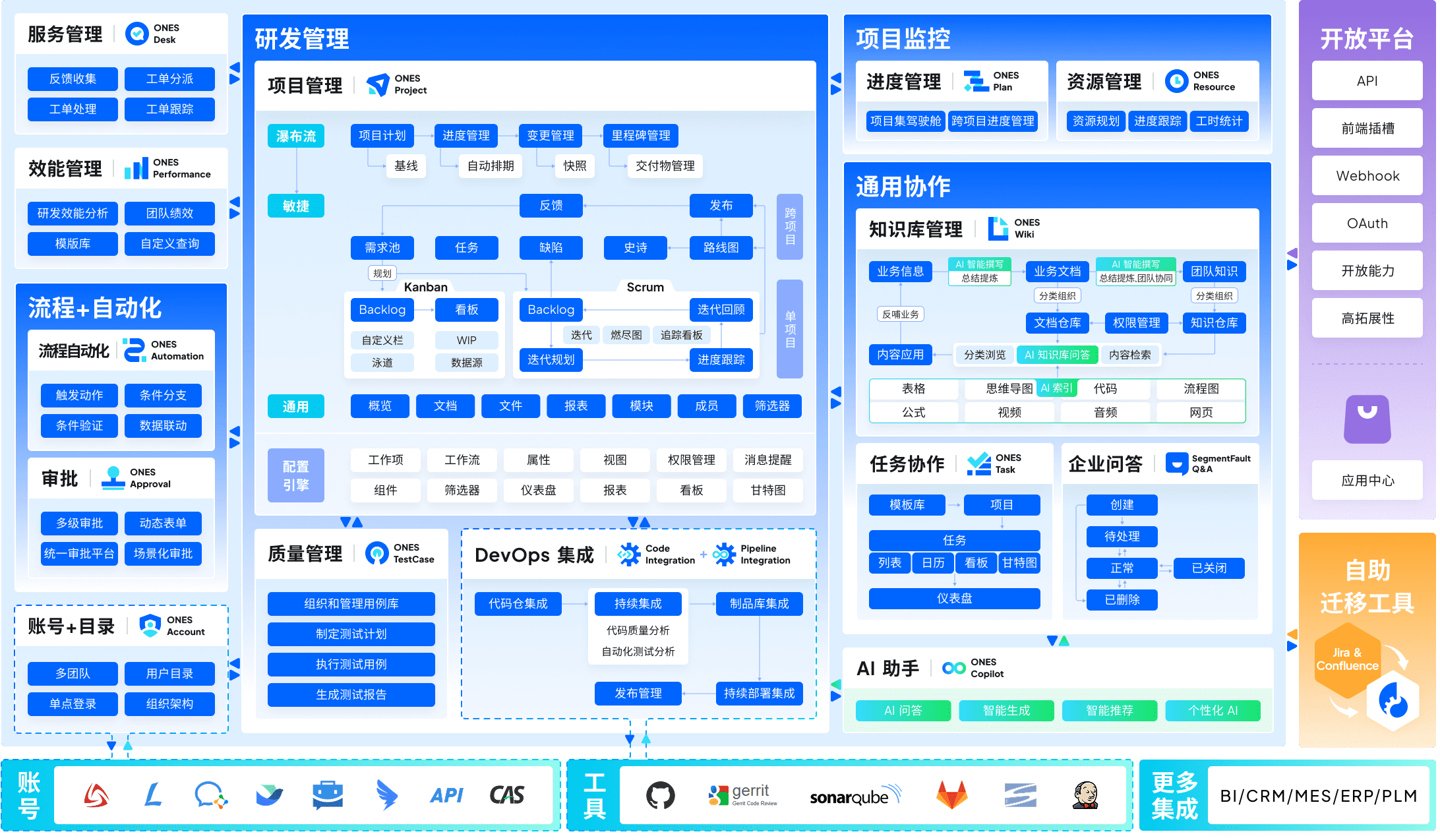
ONES serves as an enterprise-grade research and development management platform. Its architecture unifies project management, requirements tracking, knowledge repositories, test management, continuous integration pipelines, and code management within a single system. This consolidation reduces the fragmentation typically created by stitching together separate tools for documentation, task tracking, and delivery governance.
The platform addresses organizations operating at substantial scale, with support for sophisticated workflow configuration, granular permission models, and cross-functional team coordination. A distinguishing emphasis lies in engineering effectiveness measurement—providing quantitative foundations for improving delivery quality and operational efficiency rather than relying on anecdotal assessment.
For teams currently managing Confluence alongside separate project trackers and code review systems, ONES eliminates the context switching and integration maintenance overhead. Specifications connect directly to requirements and delivery artifacts. API documentation, sprint retrospectives, and release notes coexist in a searchable environment with unified access controls. The platform maintains functional equivalence between cloud and isolated deployments, which proves critical where data sovereignty or security classification mandates physical infrastructure separation.
Strengths: Unified R&D lifecycle coverage; native air-gapped deployment without capability reduction; integrated metrics for delivery improvement.
Considerations: Enterprise orientation may exceed requirements for small teams seeking simple wiki functionality.
ClickUp
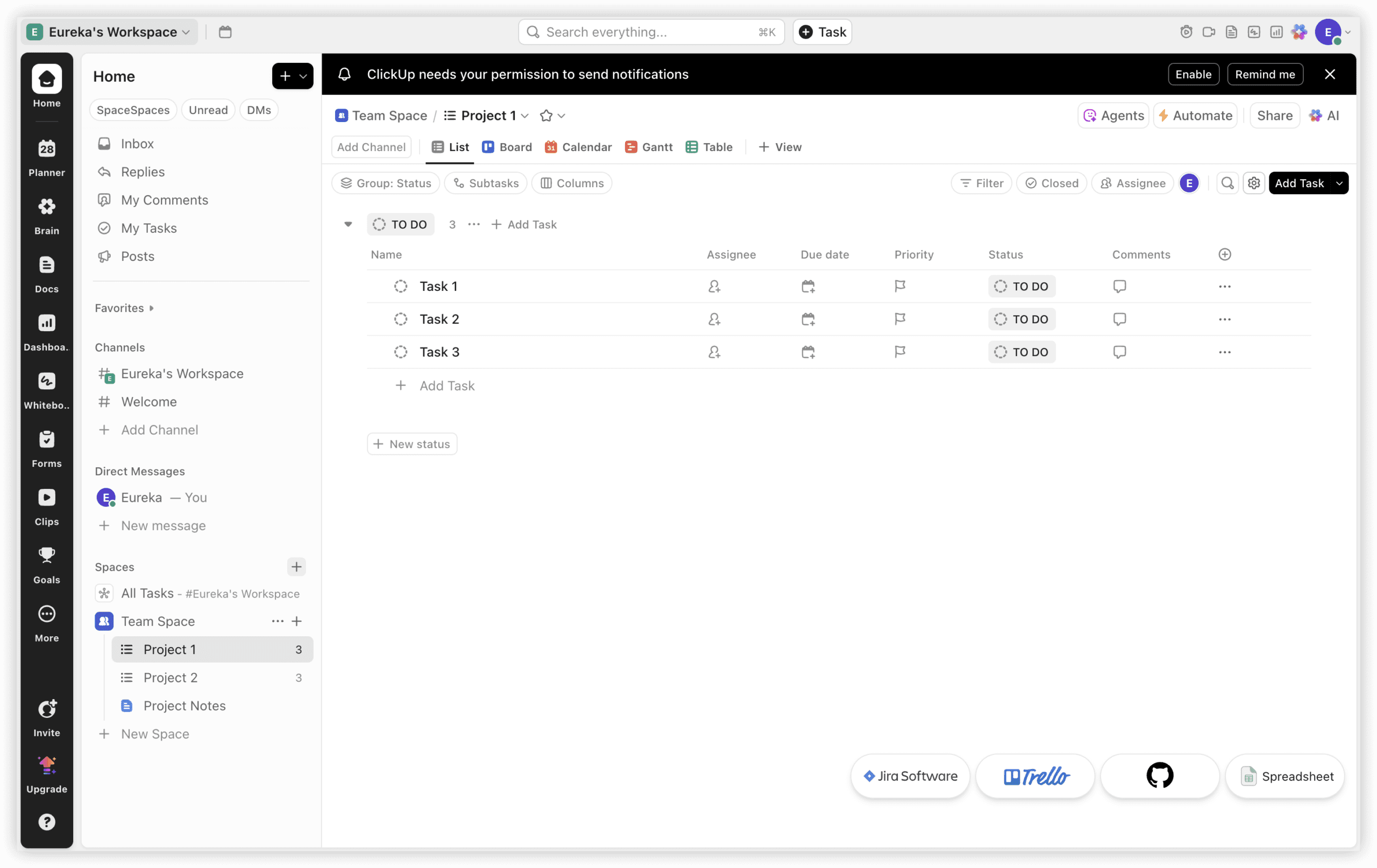
ClickUp structures documentation within a project hierarchy, making it suitable for teams that conceptualize knowledge work as subordinate to task execution. Documents reside within spaces, folders, and lists that mirror project organization, creating natural association between explanatory content and actionable items.
The platform accommodates varied view preferences—lists, boards, calendars, and Gantt representations—though this flexibility introduces configuration complexity that smaller teams may find disproportionate. Real-time collaborative editing functions adequately for most scenarios, though extensive concurrent modification of complex pages occasionally produces sync latency.
Migration from Confluence requires restructuring content into ClickUp’s hierarchical model, which may not map cleanly to existing space organization. The free plan’s storage limitations (100MB) effectively push active documentation teams toward paid tiers.
Strengths: Tight coupling of documentation and project tracking; versatile view options; established market presence with extensive template library.
Considerations: Feature density creates learning curve; storage constraints on free tier; cloud-only deployment limits regulated use cases.
Coda
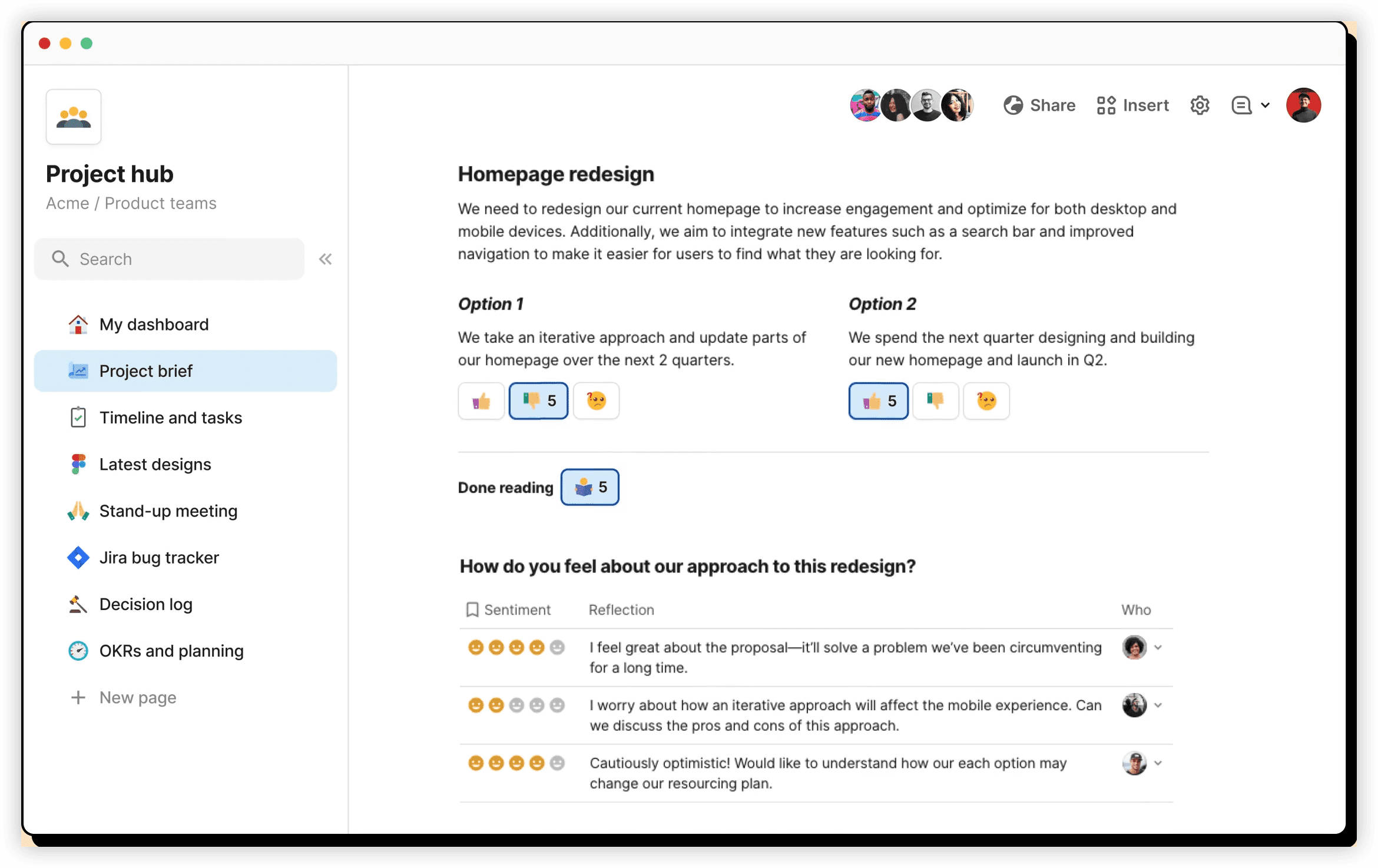
Coda treats documents as programmable surfaces rather than static pages. Tables function as databases; buttons trigger automations; integrations pull live data from external systems. This architecture suits teams building operational dashboards, planning tools, or lightweight applications within familiar document metaphors.
The platform excels where documentation must actively calculate, filter, or respond to changing data. Product requirement documents that reference live sales figures, project trackers that automatically notify stakeholders upon status changes, or resource allocation sheets that sum across multiple teams demonstrate Coda’s differentiation from conventional wikis.
This power introduces corresponding complexity. Documents that begin simply tend to accumulate interactive elements over time, potentially creating maintenance burden. The fifty-document limit on free plans constrains evaluation scope for document-heavy organizations.
Strengths: Document-as-application paradigm; robust two-way integrations; dynamic content capabilities beyond static text.
Considerations: Complexity escalation risk; cloud-only availability; free plan document limitations.
Slite
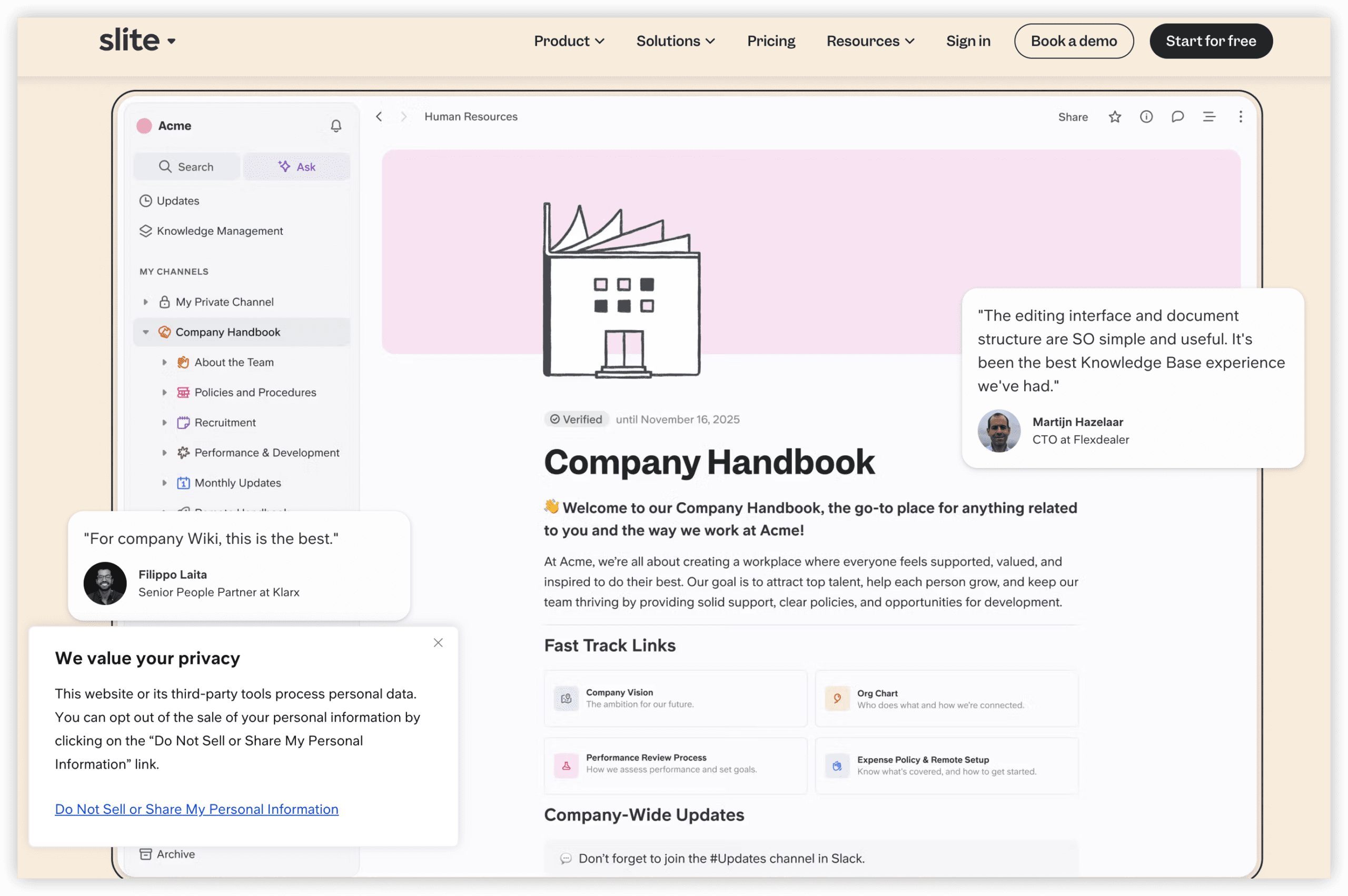
Slite prioritizes velocity in knowledge capture and retrieval. The interface minimizes structural overhead, presenting a clean writing environment with immediate search accessibility. AI-assisted discovery helps surface relevant documents based on query intent rather than exact keyword matching, addressing the common failure mode of well-documented but unfindable information.
The platform suits teams where documentation adoption already faces cultural resistance. Reduced friction in creation and discovery can shift organizational behavior toward more consistent knowledge sharing. However, the streamlined approach sacrifices governance depth—permission models remain relatively coarse, and integration with external engineering systems requires additional tooling.
Slite’s cloud-only model and limited administrative controls position it primarily for smaller teams without stringent compliance requirements or complex organizational boundaries.
Strengths: Minimal cognitive load for authors and readers; effective AI search; rapid implementation.
Considerations: Limited governance granularity; cloud-only deployment; constrained integration ecosystem for development workflows.
Tettra
Tettra focuses on repetitive question resolution through structured internal Q&A. Rather than building comprehensive encyclopedic documentation, the platform captures answers to frequently posed questions and surfaces them proactively through Slack integration. When team members ask questions in channels, Tettra suggests existing documented responses before new manual answers become necessary.
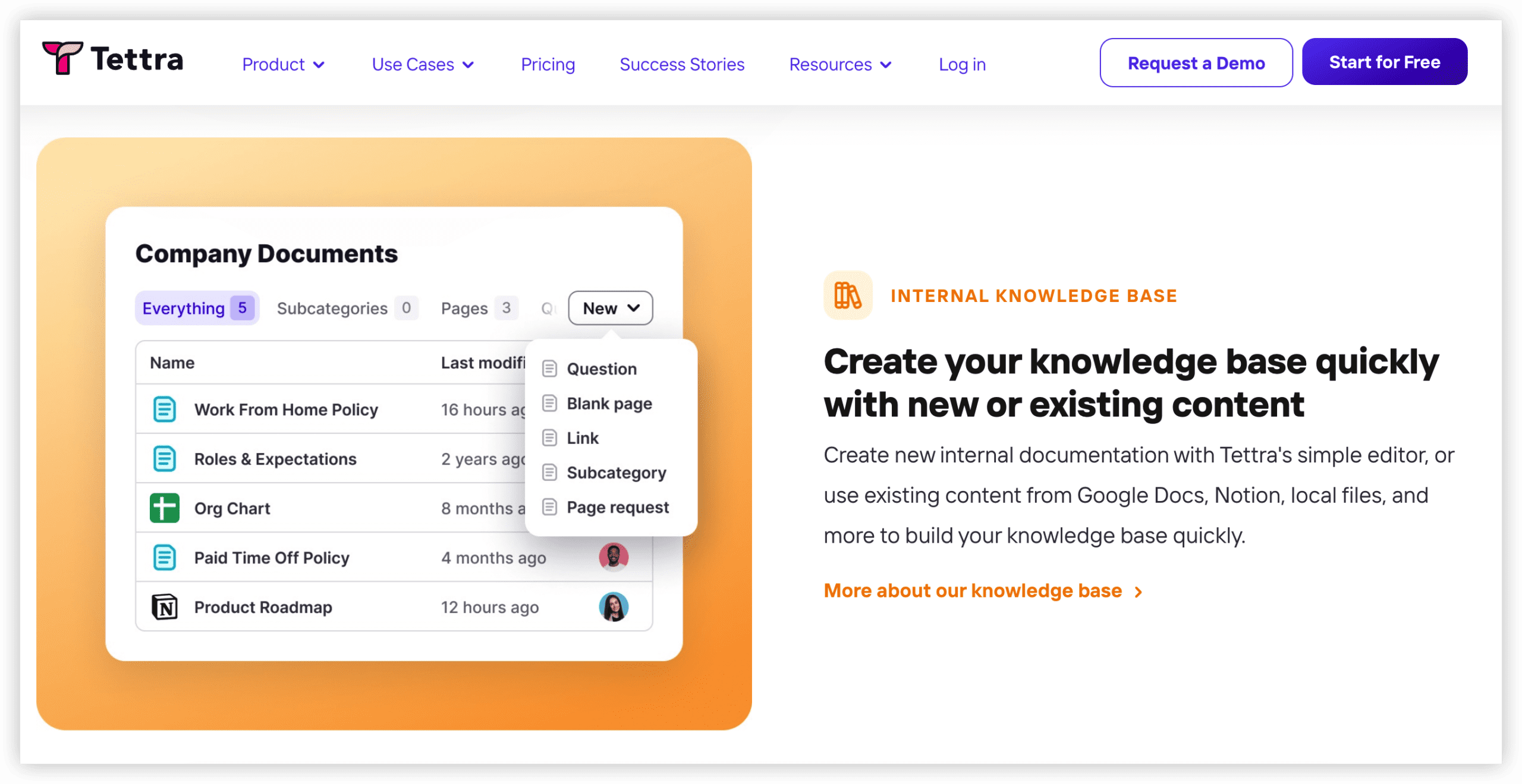
An automated verification system prompts subject matter experts to confirm or update answers periodically, reducing the staleness that degrades trust in knowledge bases over time. This approach proves particularly effective for operational procedures, policy clarifications, and onboarding guidance that recur predictably.
The narrow focus creates clear boundaries. Tettra does not attempt to replace comprehensive technical documentation or project planning artifacts. Teams requiring those capabilities need complementary tools.
Strengths: Slack-native workflow integration; automated content freshness verification; targeted problem-solution fit for internal support.
Considerations: Narrow scope excludes many documentation needs; ten-user free plan limitation; cloud-only with limited enterprise governance.
BookStack
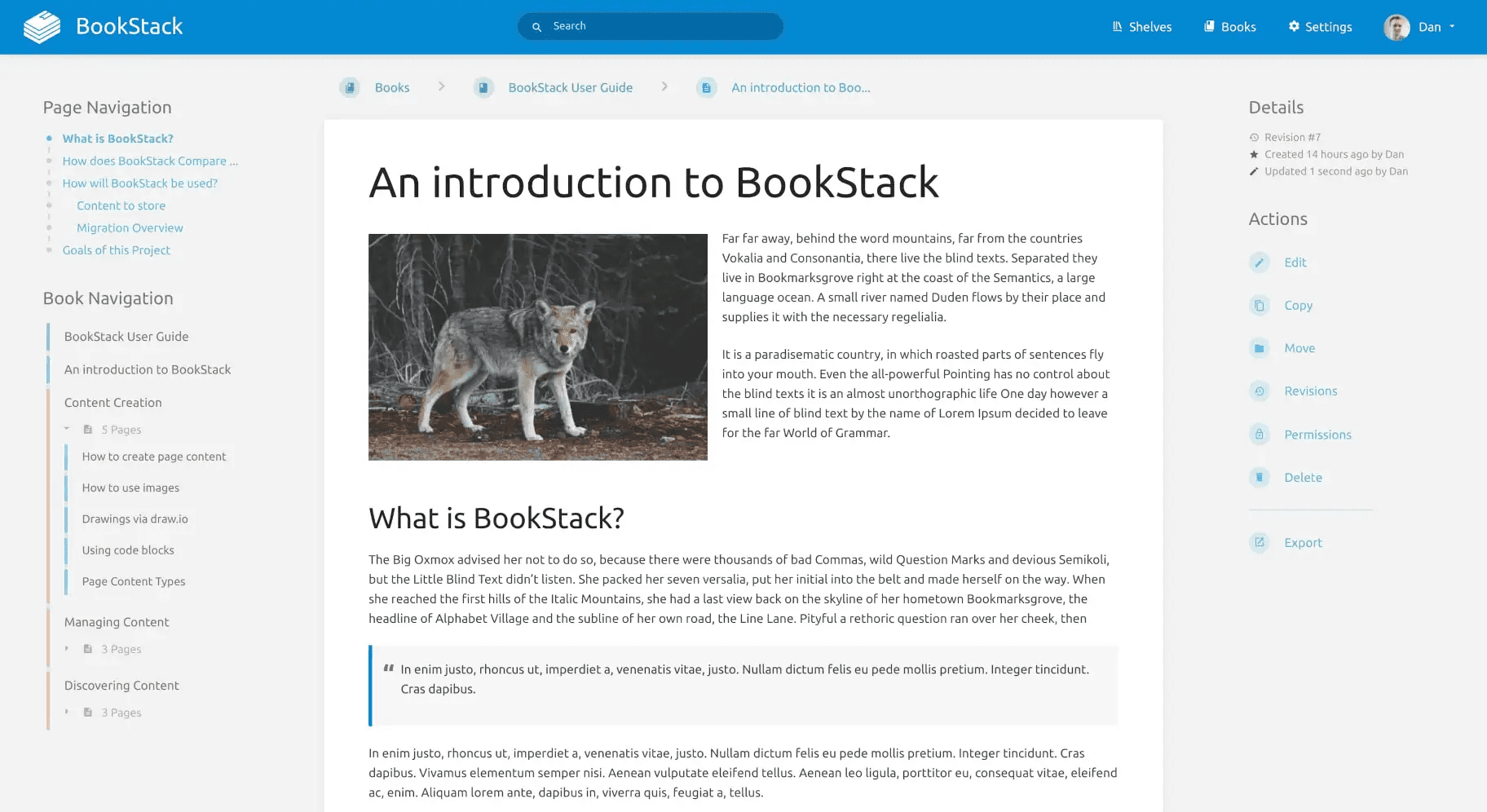
BookStack provides open-source wiki software designed for straightforward self-hosting. The architecture organizes content into books, shelves, and chapters—metaphors that guide intuitive structuring without imposing rigid constraints. A WYSIWYG editor eliminates markup language requirements for contributors, broadening participation beyond technically proficient users.
As community-supported software, BookStack incurs no licensing costs but requires internal technical capacity for installation, maintenance, security patching, and scaling. The feature set remains deliberately constrained compared to commercial alternatives, emphasizing stability and clarity over extensive configurability.
Migration from Confluence demands export, transformation, and import processes that preserve or reconstruct content relationships. The open-source community provides tooling and documentation for common scenarios, though complex Confluence deployments with extensive macros or marketplace extensions face significant reconstruction challenges.
Strengths: Zero licensing expenditure; complete data control through self-hosting; conceptual clarity in content organization.
Considerations: Internal operational burden for infrastructure management; limited commercial support options; migration complexity for elaborate existing deployments.
Selection Framework
Matching organizational requirements to platform capabilities requires explicit assessment across several dimensions:
Deployment Constraints: If regulatory or security classification mandates physical infrastructure isolation, evaluate only ONES (air-gapped) or BookStack (self-hosted). Cloud-only options eliminate themselves regardless of feature appeal.
Integration Depth: Teams seeking unified R&D management without tool fragmentation should prioritize platforms with native development lifecycle coverage. Peripheral integrations through generic connectors typically create synchronization failures and visibility gaps.
Governance Sophistication: Complex organizational structures with cross-functional matrix management require granular permission inheritance, audit logging, and administrative delegation. Simplified tools may function initially but constrain scaling.
Content Velocity vs. Longevity: Rapidly evolving operational knowledge favors Tettra’s verification model or Slite’s search accessibility. Stable technical specifications benefit from ONES’s lifecycle linkage or BookStack’s archival clarity.
Total Cost Projection: Beyond subscription fees, incorporate migration execution, administrator training, ongoing integration maintenance, and potential productivity disruption during transition.
Summary and Recommendations
For engineering organizations navigating Atlassian Data Center end-of-life with strict deployment requirements, ONES offers unified R&D management with preserved capability across cloud and isolated infrastructure. The integration of documentation with requirements, testing, and delivery governance eliminates the fragmentation that otherwise necessitates extensive custom integration development.
For project-centric teams without deployment constraints, ClickUp provides functional documentation-project coupling at moderate complexity cost. For document-as-application scenarios, Coda enables interactive content that conventional wikis cannot replicate. For rapid knowledge capture with minimal overhead, Slite reduces adoption friction. For repetitive question resolution, Tettra’s Slack integration and verification automation address specific organizational pain points. For cost-constrained self-hosting with acceptable operational responsibility, BookStack delivers foundational wiki capability without licensing expenditure.
The migration timeline from Confluence Data Center extends beyond initial tool selection to encompass content audit, restructuring, user transition, and integration reconstruction. Organizations benefit from initiating evaluation processes well in advance of the 2029 deadline to accommodate iteration and organizational change management.
Frequently Asked Questions
What drives Confluence alternative evaluation in 2026?
The March 2029 Atlassian Data Center end-of-life creates mandatory migration pressure for self-managed deployments. Simultaneously, cloud subscription economics frequently exceed historical on-premise expenditure, while data residency regulations in jurisdictions including China, EU member states under GDPR, and regulated US industries prevent straightforward cloud transitions. These converging factors make proactive alternative assessment operationally prudent.
Is Confluence Cloud migration preferable to platform replacement?
For organizations without deployment restrictions and with manageable subscription cost increases, cloud migration preserves existing content structures and user familiarity. However, data sovereignty requirements, third-party app dependencies unavailable in cloud, custom plugin investments, and significant cost escalation frequently make alternative platforms more sustainable long-term.
Does ONES support physically isolated network deployment?
Yes. ONES maintains functional equivalence between cloud, private cloud, on-premise, and air-gapped deployments. This parity ensures that security or regulatory requirements for physical network isolation do not necessitate capability sacrifice or separate product versions.
Which option suits minimal wiki requirements without engineering integration?
Slite or BookStack address straightforward documentation needs without surrounding capability complexity. Slite suits cloud-acceptable environments prioritizing search and speed; BookStack serves self-hosting requirements with zero licensing cost.
Can software development lifecycle management occur within ONES documentation?
Yes. ONES explicitly integrates knowledge management with requirements definition, task tracking, test management, and continuous delivery pipelines. Specifications connect to implementation tasks, test cases reference requirements, and release documentation ties to deployment artifacts—creating traceability that separate wiki and development tools struggle to replicate without extensive integration investment.